When I was first introduced to investing, I had the same mindset I see in a lot of university students and young professionals today: it’s not worth starting yet.
I remember wanting to open a TFSA in my 1st year of university, then reality hit. Between rent, tuition, groceries, and everything else, I was making around $23/hour and had maybe $100/month left over. That is when I didn’t waste most of it at the bar.
I thought, what’s even the point?
Even if I invested that $100/month for a full year and earned an optimistic 10% return, I’d only make $120. That didn’t feel worth the effort of opening an account, figuring out what to invest in, and keeping track of it all.
So I didn’t.
I couldn’t have been more wrong.
The Story of Ben and Arthur
I’d like to share with you an example my 2nd year Personal Finance professor gave to me in university that completely changed how I viewed investing – the story of Ben and Arthur.
Imagine two friends – Ben and Arthur. They’ve known each other since public school and do everything the same, except for investing that is.
As soon as Ben turned 19, he began investing $2,000/year into a 100% equity portfolio. At age 26, he made one final $2,000 contribution, then stopped forever. He never invests another dollar for the rest of his life
Arthur, on the other hand, figured he’d enjoy life while he was young and just invest more later when he’s making more to catch up. At 27, Arthur finally starts investing. Just like Ben, he begins making contributions of $2,000/year in a 100% equity portfolio and continues to do this until he reaches age 65.
At age 65, Ben invested a total of $16,000 and Arthur invested a total of $78,000.
Who do you think had the bigger portfolio at age 65?
You guessed it – Ben did, by over $700,000.
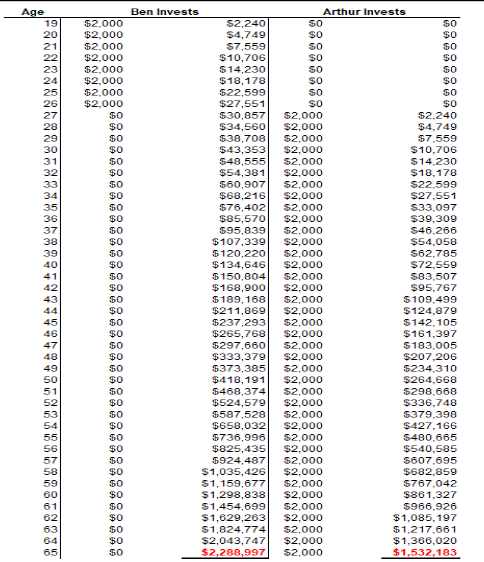
Let that sink in for a second. He invested $62,000 less of his own money and only contributed for 8 years, yet still ended up with significantly more than Arthur, who invested consistently for nearly 40 years.
That’s the magic of compound investing and starting early.
You Can Find Compounding Everywhere
If there are two things that matter most when it comes to building wealth, it’s time and compounding, and as a young professional, you’re in the perfect position to take advantage of both.
If you haven’t read it, I highly recommend you read The Psychology of Money by Morgan Housel. One chapter discusses the phenomenon of compound investing – here are some examples he gives that will completely change how you think about growth.
We all know Warren Buffett – commonly referred to as the greatest investor ever. As of 2020 his net worth $84.5 billion.
But did you know that $84.2 billion of that came after his 50th birthday?
Let’s put that into perspective.
Buffett began serious investing at 10 years old. But imagine a different scenario – he spends his 20s enjoying life, traveling, not worrying about investing, and only starts at 30. Let’s say he still earns the same incredible returns he’s known for (around 22% annually) but decides to stop investing at 60 to spend time with family. How much would he be worth?
$11.9 million.
Still a great outcome, but nowhere near $84 billion. And the only difference? Time.
The idea of compounding isn’t just limited to money. Let’s think about something completely different: ice ages.
There is evidence of five distinct ice ages in Earth’s history, but have you ever taken a moment to think about what causes these cycles?
There had been numerous theories up to the early 1900s as to why they occurred, but none of them could fully explain the cycle of ice ages – until Wladimir Köppen dug deeper.
It wasn’t brutally cold winters that created ice ages, it was cool summers.
When summers weren’t warm enough to melt the previous winter’s snow, a small layer of ice would remain. That leftover ice made it easier for more snow to stick the following winter. Then even more the next year. And the next.
That tiny, almost unnoticeable accumulation which repeated over hundreds of years eventually turned into massive continental ice sheets.
Not because of one extreme event, but because of consistent, incremental buildup over time.
If there’s one thing I hope you take away from this, it’s this:
It is always better to start today than tomorrow.
Not just with investing, but with anything that compounds over time.
You might not notice the impact in a month. Or even a year. Maybe not even in 10 years.
But one day, you’ll look back and think:
“I’m really glad I started when I did.”
So, if you’re on the fence…
Put the $100 in.