
This article probably won't bring in too many readers, but I'm writing it anyways.
Listen, I know nobody (pretty much anyways) finds tax interesting. It's incredibly dry and depending on the situation, can be pretty complex. Reality is though, this is important stuff, and if you move through life and don't consider the tax implications when big things happen, you'll be paying the government way more than you need to. Do you really want to pay tens of thousands of dollars more in taxes than you need to?
Here's a question for you. What do you think is the biggest expense you'll incur in your life? Food? Clothing? Kids? A house?
All wrong. The typical person will pay more in taxes during their life than any other expense. I don't know about you, but that alone makes me want to minimize how much tax I pay alone.
And there's never been a better time for me to write this. About a month ago, I finished reading "101 Tax Secrets for Canadians" by Tim Cestnick so for once, I'm actually a little excited to talk about taxes.
In this article, I am going to go through 10 tips that can be useful to you as early as your 20s. And by the way, if you're not already, I'd highly suggest you start completing your tax returns yourself, rather than your parents or an accountant. Most of you will have very simple tax returns so now is the best time to learn, and I promise it's not that difficult. If this is something that you might be interested in learning more about, feel free to book some time with me and we can go over it together.
Okay, here we go.
1. Understand The Basics
If you have no prior knowledge about how you're taxed and the different components of your tax return, I'd definitely start here. There are three main components I want to touch on here, the first being understanding the difference between tax avoidance and tax evasion. One is okay, and the other definitely isn't.
Tax avoidance is simply structuring your affairs so you pay less in tax - which you have the right to do. Tax evasion, on the other hand, is attempting to reduce your taxes illegally, such as making falsifying income or making up deductible expenses. What happens if you get caught evading taxes you ask? You'll face penalties equal to 50% of those taxes, as well as face interest charges from the year of the crime until you pay off the taxes and penalties owing. In short, it's not worth it.
The second part of taxes you have to understand is your marginal tax rate. Your marginal tax rate is what you are taxed on your last dollar of income. Below is a chart outlining the marginal tax rates for 2025.
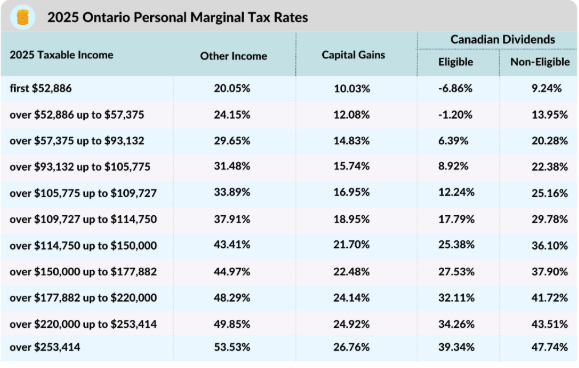
So, let's say you earned $70,000 in income this past year. How much tax would you have paid if you earned one more dollar? The answer is 29.65 cents, and you'd keep 70.35 cents. Your marginal tax rate mainly depends on three things: your province of residence, level of income earned, and type of income earned. As you can see, the higher your income, the more you'll be paying in taxes.
The last basic you should understand is the difference between deductions and credits. When you file your taxes, you start with your amount of taxable income. Deductions can then be claimed to lower your taxable income, and therefore, the amount in taxes you pay. After accounting for deductions, you multiply your new taxable income number by current federal and provincial tax rates to see how much you'll pay in federal and provincial tax.
We're not done yet though. Once you determine your federal and provincial tax numbers, these amounts are reduced by any credits that you claim to arrive at your basic federal and provincial tax bills. Finally, add provincial surtaxes where applicable and you arrive at your total tax bill.
From this, we can conclude that credits are generally more valuable than deductions. With a deduction, you are reducing your total tax bill by an amount equal to your marginal tax rate. For example, if your taxable income for the year was $70,000, you are at marginal tax rate of 29.65%. If you then claimed deductions of $10,000, you would have saved about $2,965, or 29.65% of $10,000. Credits, on the other hand, will save you tax dollar for dollar. A $100 tax credit means you are actually saving $100 in taxes.
One last important note on credits - there are two types of credits: non-refundable and refundable. Non-refundable credits can be used to bring your tax owing down to $0, but no further. Refundable credits, on the other hand, can provide relief beyond $0, resulting in a cash refund.
2. Deferring Tax Through Different Investment Accounts
Certain investment accounts allow for tax-deferred growth, allowing your investments to grow within them tax-free. The benefit of this is you can delay paying tax to when your income is lower, resulting in a smaller tax bill. In addition, any contributions to these accounts during the calendar year are deductible and therefore, reduces taxable income for the year. There are 4 different accounts that achieve this, as explained below.
Registered Retirement Savings Plan (RRSP)
Many of you are likely familiar with RRSPs, so I won't get into too much detail, but the key benefits to using this account are exactly what's described above. Each year, you are able to contribute up to 18% of your earned income for the previous year up to a maximum amount determined by the government each year. In addition, unused contribution room is carried forward indefinitely from the time you filed your first tax return reporting earned income. Growth in the account is entirely tax-free until you begin withdrawing money from it.
Registered Pension Plan (RPP)
A RPP operates much like a RRSP, but is sponsored through your employer. You contribute a percentage of each paycheck directly to your RPP, and often your employer will match your contributions up to a defined percentage.
One important thing to note, all contributions to your RPP - both from yourself and your employer - will reduce your available RRSP contribution room. This is called a pension adjustment (PA). If your RPP is structured as a Defined Contribution Pension Plan (DCPP), which is how most pensions are structured, the pension adjustment calculation is simple.
For example, let's say your earned income was $80,000 last year and the total contributions to your RPP between yourself and your employer was $6,400 - this would be your pension adjustment. Your available RRSP contribution room for that year would be $14,400 ($80,000 * 18%) - $6,400, which comes out to $8,000. This is important to ensure you don't overcontribute to your RRSP which leads to penalties.
First Home Savings Account (FHSA)
As the name implies, available to only first-time homebuyers, the FHSA essentially combines features of a RRSP and a Tax-Free Savings Account (TFSA). Any contributions made to the account can be deducted from your taxable income on your tax return and when it comes time to buy a house, you can withdraw the money in the account entirely tax-free. You can contribute up to $8,000 to a FHSA each year, in addition to any carryover room from the previous year, up to a lifetime maximum of $40,000.
Deferred Profit Sharing Plan (DPSP)
A Deferred Profit Sharing Plan is another employer sponsored plan where only your employer can contribute. Your employer can contribute up to 18% of your income or whatever the stated annual maximum is, whichever is less. Your funds grow inside the DPSP tax-deferred and you pay tax on the amounts paid out of the DPSP to you. You can spread DPSP payments to you out over a maximum of 10 years so you're not taking a tax hit of the full value of the account. Additionally, if the income isn't needed, you could also consider rolling some of the money into your RRSP, RPP or term annuity to defer tax even further.
3. Tuition, Scholarships, and Grants
If you're a post-secondary student, you've likely heard of a T2202 form. If not, this is the form you use to claim your tuition tax credit, which is a non-refundable tax credit. All eligible tuition fees, such as your actual tuition cost and any admin fees can be claimed. There are some tuition fees that are ineligible, however, such as student association fees, residence fees, and textbooks and supplies. Once you've calculated, the total amount of eligible fees, multiply it by the lowest federal tax rate (currently 14%) to arrive at your final tuition tax credit.
Another important thing to note is if you are enrolled in post-secondary full-time, scholarships and grants are usually tax-free income. Make sure to report this separately from your taxable income in Box 105 on your T4A slip.
4. Track Moving Expenses
If you move for the purpose of work or school, and your new home is at least 40 kilometres closer to your new work/school location, you may be able to claim some of these expenses.
If you are moving for school, you can deduct expenses such as transportation costs, storage costs, and temporary living expenses. In order to be eligible, you must be a full-time student. You should know, however, these expenses can only be deducted from the taxable portions of your scholarships, fellowships, bursaries, certain prizes, or research grants.
If you moved for the purpose of work, you can deduct the same expenses as stated above from the employment or self-employment income you earned at your new work location.
5. Understanding How Investments are Taxed
This section likely won't be of use to many of you, since you still have contribution room in your RRSP, TFSA or FHSA, which grow tax-free. However, I do still think it's valuable to know how non-registered investments are taxed for the day you will have both your RRSP and TFSA maxed.
In general, people vastly underestimate the impact tax has on their investments and has to be taken into consideration if you have a non-registered account. When looking at how much annual tax you'll pay on your non-registered investments, it depends on two things in particular: portfolio construction and portfolio turnover.
Portfolio Construction
When I say portfolio construction, I'm referring to the types of investments you hold in your portfolio. Generally, your investments will fall into 3 broad categories.
-
Money market investments (for example, GICs, Canada Savings Bonds, and money market mutual funds)
-
Fixed income investments (for example, corporate bonds, government bonds, and mortgage-backed securities)
-
Equity investments (for example, stocks, mutual funds, and real estate)
Money market and fixed income investments generally provide you with interest income and in the case of preferred shares, dividends. Equity investments provide opportunity for capital gains. It's important to understand how each of these are taxed.
Using the same marginal tax bracket from earlier, if your taxable income came out to $120,000, you'll face marginal tax rates as follows:
-
Interest income: 43.41%
-
Capital gains: 21.70%
-
Eligible dividends: 25.38%
-
Non-eligible dividends: 36.10%
As you can see, money market and fixed income investments are generally not tax-smart, while equities make a lot more sense from a tax perspective. Let me show you how much of a difference this makes through an example.
Let's say you have $100,000 to invest for a 20 year period, which you will then liquidate. We will assume each investment returns 8% annually and your marginal tax rate is 45%. Let's see the difference in the end value of each.
Portfolio Construction | Balance Before Taxes | Balance After Taxes |
|---|---|---|
Money Market (100% interest income) | $236,597 | $236,597 |
Balanced (50% interest, 50% deferred capital gains) | $333,035 | $299,207 |
Equity (100% deferred capital gains) | $466,096 | $383,724 |
So, by investing in equity rather than money market, at the same rate of return, your after-tax portfolio would be worth 62% more after 20 years.
Portfolio Turnover
Every time you place a trade, or liquidate an investment then reinvest your money in another investment, you are triggering a taxable event (as a reminder, this is the case ONLY for non-registered accounts). So now, when you make that trade, not only does it have to provide you with the rate of return you were expecting, but it also needs to make up what you paid in taxes. You should keep this in mind if you're trading regularly or are holding actively managed mutual funds in a non-registered account.
6. Income Splitting
If you're married or have a common-law partner, income splitting tends to be a great strategy in relationships where there is a large discrepancy between each person's income. Essentially, the higher-earning partner can transfer a portion of their income to the lower-earning spouse. This transferred income is then taxed at the lower earner's marginal tax rate, and can decrease the household's total tax bill.
Income splitting is most commonly used closer to and during retirement, although an income splitting strategy you could use now would be through a spousal RRSP. For example, take the couple of Mark and Mary, both in their mid 30s. Mark earns $60,000 per year and Mary earns $150,000.
The strategy here is rather than have Mary place all her savings into an individual RRSP, they can open a spousal RRSP so Mary can contribute part of her savings to it. The goal is to have the spouses' RRSPs to be of roughly equal value by retirement. These two smaller RRSPs rather than one large one results in a lower combined tax burden when you begin to draw income from it.
While this is a relatively simple strategy, I do want to point out income splitting can be complicated and there are many rules surrounding it. I would recommend speaking to an accountant to ensure it makes sense for you and is done properly.
7. If You're Self-Employed...
Self-employment provides a TON of tax planning opportunities and strategies for saving. Of course, I couldn't possibly cover everything here, but want to point out some of the more significant opportunities and points to be aware of.
Understand the Difference Between Business and Employment Income
If you are currently an employee, what you earn is employment income. If you run your own business, what you earn is business income. There are some important differences between the two to be aware of.
Employment Income | Business Income | |
|---|---|---|
Income tax deductions | Income tax is usually deducted from each paycheck by your employer. | Tax is NOT deducted from your income. You must set aside a portion of your earnings to cover your taxes owing by the annual deadline. Usually 25-30% is a good idea. |
CPP contributions | You and your employer each pay a percentage of your salary. Contributions are deducted from your paycheck. | You pay both the employee and employer portions when you file your tax return. |
Employment Insurance (EI) premiums | EI premiums are automatically deducted from your paycheck. | EI contributions are optional. Opting in may give you access to benefits such as maternity or sickness. |
Deductible expenses | Most job-related expenses are not deductible unless you meet certain CRA conditions and is signed off on by your employer. | Various business expenses can be deducted from your income. |
Dealing with Losses From Your Business
It's not uncommon for business expenses to exceed income in the first few years of operation, resulting in a loss. The good news is, as long as your business isn't incorporated, you can apply these losses, also called non-capital losses to reduce taxable income. These losses can be carried back up to 3 years, or carried forward up to 20 years.
Know What Expenses Can be Deducted
The list of deductible business expenses is one of the main perks of self-employment when it comes to saving on tax. You can claim a deduction on essentially any cost as long as it was incurred for the purpose of producing income, the expense is reasonable, and you have proof of the expense in the form of receipts or invoices. Here are some examples.
Home Office Expenses
To claim a deduction for home office expenses, you must meet one of two criteria: (1) your home is your principal place of business; or (2) you use a specific area in your home exclusively for earning income from your business and you meet clients there on a regular basis. Once you've met the criteria, there are a number of expenses you can consider deducting from, such as these.
-
Rent
-
Property taxes
-
Mortgage interest
-
Utilities
-
Home insurance
-
Repairs and maintenance
Automobile Expenses
If you use your vehicle for the purpose of earning a profit, you can claim certain expenses to deduct from your taxable business income. If you use your vehicle for both personal and business uses, the CRA recommends using a logbook of business travel. You should include the destination, reason for the trip, the distance traveled, and tie it into a calendar if you can. Some eligible expenses include:
-
Gas and oil costs
-
Insurance
-
Interest on money borrowed to buy the vehicle
-
Maintenance and repairs
-
Leasing costs
Meals and Entertainment
Generally, 50% of any meals and entertainment costs are deductible if they were incurred to earn income. There are some situations where they are 100% deductible, such as where the meals and entertainment have been provided to all your employees, or if one of your employees incurred the expenses and had to travel outside of your metropolitan area.
Travel Costs
If you are travelling to a convention, meeting, or other business-related event, you can deduct all of your travel expenses. This includes airfare, hotels, and conference fees.
If you can't tell by now, there are a lot of nuances when it comes to tax reporting and the strategies available to reduce your tax bill. I truly believe that efficient tax planning is a key part of building wealth. And while thinking about taxes may not be the most exciting way to spend your time, consider how much of your income is already going toward taxes. Why pay more than you have to?
Over the course of your career, the difference can be significant. Two people with the exact same income, spending habits, and investment returns can end up with very different levels of wealth simply because one took the time to plan around their taxes and the other didn't.
That's also one of the reasons I do what I do. I'm sure most of you would rather spend your time with friends and family or focus on everything else already on your plate than constantly think about the tax implications of every financial decision you make. As an advisor, my responsibility is to help you get the best of both worlds: efficient tax planning that helps you keep more of what you earn, without requiring you to spend your time becoming a tax expert.