
For many people when they were growing up (including me), in order to be successful, you're told to work hard, get a good education and find a job that pays well.
And that could be true if you're referring to being successful in your occupation. But in reality, to be financially successful and achieve the financial freedom I imagine most of us dream of reaching one day it takes more than that.
If your parents never really talked to you about money growing up, that can be hard to wrap your head around. You see the life they're living, you want your life to look similar, and according to them, following those steps is what it took to get them there.
But what they describe as the steps to financial success doesn't show the whole picture. You would be shocked at how many high income earners (over $200,000 annually) struggle financially. They might have the nice cars or big house to mask it, but it's not uncommon to see these high-income earners living paycheck to paycheck. This is someone who is rich, but far from wealthy.
Life is absolutely more expensive today than it used to be, but what has really stopped many from becoming wealthy is largely a product of how they were raised around money and how they view money now. These two are closely related and I'll give some evidence to prove it later in this article.
I also want to make an important distinction. A lot of people use the words "rich" and "wealthy" interchangeably when they are far from the same thing. Being rich is more visible. Someone who makes a lot of money and owns a big house and a nice car is rich.
Wealthy, on the hand, is what I consider true financial freedom. It's when you reach the point in your life where you realize you no longer have to work, but can fulfill your goals - whether it be travelling, leaving behind a legacy, financially supporting your children - without ever having to worry if you can afford it. If you make $500,000 a year, but spend most of it to continue living a luxurious lifestyle, that isn't wealth. You need to keep working hard to make sure your income keeps up with your spending. That's the difference.
From what I've observed with the clients we work with, as well as research documented in different finance-related books I've read, these are the 5 traits you need to consistently display to eventually become wealthy.
1. Discipline
Starting out with what is arguably the most important trait out of any others that will be listed here. Many of you reading this will be early in your career, and if you've landed a role with a company you can see yourself staying with, you're probably trying to work yourself up the ladder.
What's an important trait to possess to push yourself up that ladder? You guessed it - discipline.
You need the discipline to continuously do things that others aren't to make you stand out. You need to create good habits for yourself, like getting enough sleep each night and exercising. Some days you might not feel like doing something you know you should, but pushing through will eventually just turn it into routine. Success rewards consistency.
There's an interesting observation to be made though. Remember our high earner example from earlier? He must have shown discipline to get to where he is. So why isn't that discipline translating to managing his finances as well?
Most of it can be tied back to psychological and social reasons. I mentioned it briefly earlier, but the way you view money today is heavily influenced by your parent's money habits when you were a kid. Research backs this up too: the University of Cambridge found that you begin to form fundamental money habits as early as age 7.
Think about it like this: if you grew up in a wealthy neighbourhood, lived in a beautiful home, replaced your vehicles every couple years, and got spoiled as a kid, it makes sense that when you grow up, you will value the same things and also crave an expensive lifestyle. It's just what you've become accustomed to.
On the other hand, if you were raised by immigrant parents who became entrepreneurs, how you view the world is different. You've seen your parents live below their means, which is what you become accustomed to. What was important to them probably wasn't getting a brand new car every 3 years, but rather ensuring their kids get a good education so they can grow up to be a doctor or lawyer and not go through the same struggles they did.
"The Millionaire Next Door" actually did some research on this. Here are some facts about the wealthy you may find interesting (as of 1996, when the book was written):
-
80% of America's millionaires are first-generation rich and typically the fortune built by the 1st generation will be entirely dissipated by the 2nd or 3rd generation
-
On average, their annual realized income makes up less than 7% of their wealth
-
The more economically successful offspring are likely to receive smaller levels of financial support from their parents and inheritance
How do each of these relate to being disciplined?
-
Most millionaires are first-generation rich because they haven't become accustomed to a high-consumption society. As this wealth is passed down through the generations, their kids are raised in such a society WITH money.
-
Of course, if your income makes up only 7% of your total wealth, it means you are living well below your means.
-
Those raised in affluent families who receive less financial support from their parents were more likely to be taught about frugality and discipline growing up and are therefore more self-sustaining.
These are just some stats out of probably a hundred given in that book that prove the importance of discipline if you wish to become wealthy. They don't sacrifice their savings and future for their wants of today, they live below their means, they stick it out in the market even during tough times, and maybe most importantly, they prioritize financial independence over social status.
We live in a high-consumption society, one of which many of us were raised in and have become used to. Most people can't escape the constant desire to consume and aren't willing to sacrifice their wants now for delayed gratification.
It's not easy to be disciplined, absolutely. That's why 50% of Canadians are living check to check.

2. Proactiveness
Here's a little secret for you: the more time you give yourself to build wealth, the easier it becomes.
As you know, I work mainly with clients in their 20s and 30s and this is the main thing I preach: be proactive and start taking your finances seriously. If you do, everything will become easier for you later on when your financial situation becomes more complex.
I hear people all the time (especially those still in university or recently graduated) use their circumstances as an excuse to just wing their finances. You're not doing yourself a favour waiting for a "better time to start" which will never come, you're just procrastinating. I'd bet you most Canadians have said the same thing: "I'll just start when..." - perhaps offering another explanation of the financial struggles of so many in this country.
In school and not earning an income? Make financial goals for yourself. Start tracking where your money goes. Familiarize yourself with different investment vehicles and accounts so you have a plan when you are earning an income.
Graduated recently and entering your first job in your career? Save at least 20-25 of your income (this should be more like 30-35% if you're still living at home). Become familiar with your employer's benefits and take advantage of any employer match to their group plan. Start planning for your future home purchase.
Being proactive with your money is important for two reasons. First, it creates good habits. A lot of people tend to think what they do with their money now doesn't matter as much when they're young and they'll take care of it "when I make more money". The problem is, it is very difficult to change your lifestyle on a dime like that.
If you're in an entry-level role, receive your paycheque, then spend most of it before you get your next one, you develop a consumption-based lifestyle. You see something you want and you get it. Fast forward 10 years when you've become a high-earner, do you think that urge to consume is magically going to disappear? It's very unlikely. Not to mention, now you have a family, a mortgage, groceries... the costs of your needs will have gone way up and before you know it, your spending is actually outpacing your increases in your annual income.
Create good habits for yourself early. Put a good chunk of your income towards your savings, track where your money goes, and make sure the wants come last.
The second reason it's important to be proactive is, of course, because of this wonderful thing called compound interest. Any investor will tell you that the key to getting great returns isn't the company or the sector you invest in, it's how long your investments have to grow.
Let me give you an example to prove the importance of compound interest. Warren Buffett, the greatest investor of all time, had a net worth of $84.5 billion as of 2020. Since he started investing at 10 years old, he's earned around 22% annually, which is pretty insane.
Even with those crazy returns year after year, $84.2 billion of his net worth came after his 50th birthday - aka 40 years after he started investing.
Now imagine Warren decided to live his best life in the 20s and defer any kind of saving or investing until he turned 30. With those same 22% returns, his net worth would be around $11.9 million!
By the time Warren got older and had been investing for decades, the effects of compound interest became so significant and literally grew exponentially each year. Had he missed out on those 20 years, his net worth would be 0.00014% of what it is today.
I'll say it again: if you have a long-term horizon, time always beats investment selection.
Take advantage of it.
3. Patience
To achieve success in anything, you need to be willing to play the long game. Whether it be your career, picking up a new skill, learning a new sport, or in this case, accumulating wealth. Without the patience to see it through, it probably isn't going anywhere.
In 1970, Dr. Edward Banfield of Harvard conducted a really interesting study on success, called "The Unheavenly City". Essentially, he was trying to figure out why some people became financially independent while others couldn't.
The results said those most successful in life were those with a long time perspective.
What does this mean? It means successful people considered the future in all their decisions. Rather than acting impulsively and doing something that will only benefit themselves now, they step back, take a moment to think, and ask themselves if they will be glad they made said decision 10 years from now.
There are two big areas in your finances where patience is especially important. The first is your saving and spending habits. So many today are fueled by instant gratification and lack the self-control to stop themselves and look at the bigger picture. It's harder to save than spend because the benefits of it cannot be felt today. It requires patience to reap many of the benefits of strong financial habits - something many people lack.
The second big area is with your investments. Being a patient investor has been made significantly more difficult with social media. You can find financial advice everywhere online, not to mention all the constant noise and headlines. The worst ones are the people who flat out tell you a company, mutual fund, ETF or whatever it is that "everyone should be investing in".
If you are regularly looking at your portfolio and make trades frequently, you are making things harder for yourself. When you trade one fund for another, not only do you need your new fund to outperform the old one, but you also incurred a fee when you made the trade. So now you need to outperform the old fund plus the fee. Do this often and you will almost always be worse off over the long run than creating a diversified portfolio and simply holding.
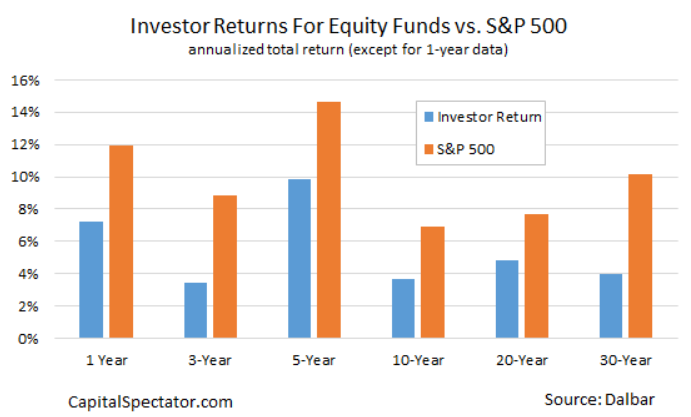
Here's some proof for you. The chart below shows returns over multiple different periods for both the S&P 500 and the average investor. And guess what, the S&P won every single time! You could literally just buy an ETF tracking the S&P 500 and hold it and you're automatically receiving above-average returns.
4. Goal-Driven
Having both short and long-term goals are important in every part of your life, so of course the same will hold true for your money management as well.
Probably my favourite book of all time, "Think and Grow Rich" by Napoleon Hill (if you haven't read it, I HIGHLY recommend you do), talks about the 13 principles needed to build substantial wealth. One of these principles is autosuggestion, which is the idea that through constant repetition and focus, you can trick your subconscious mind to believe something is true. So, by setting a detailed goal attached with an action plan, and reinforcing it in your head daily, you will have rewired your brain to make sure it comes true.
You may not believe that to be true but think about this for an example. Take a kid who gets bullied growing up. Through continuous verbal abuse, these negative thoughts about themselves constantly get reinforced in their head. Eventually, they'll believe it to be true themselves. That's why it's common for kids who are bullied at a young age to carry a low self-esteem into their adulthood. It's essentially rewired their brain.
However, it's certainly not enough to just say "I will become a millionaire". How will you become a millionaire? When will you become a millionaire? What steps will you take to ensure you become a millionaire? Your goals absolutely must be detailed.
Remember in grade school when we used to have to make SMART goals (specific, measurable, achievable, relevant, and time-bound)? Those are the types of goals you should be making, with an action plan on how you will achieve said goal, and constantly reminding yourself of the goal to maintain the same level of desire for it as when you first made it. (This is important, don't skip it!)
You should be setting these goals for all aspects of your money management. Found somewhere you want to travel to? Decide on a realistic timeframe, figure out how much you're going to set aside for it each month, and determine other wants you may need to cutback on to ensure you can allocate that amount consistently.
Looking to buy a house? Do the same thing: figure out a target home price, give yourself a date, and list out the things you will do to make sure it happens.
You can't stumble upon wealth. Those who have it created realistic plans and stuck with them religiously to make their goal a reality.
5. Organization
You might think by organization, I mean you should have a massive Excel spreadsheet documenting all your expenses and tracking every dollar that comes in or out of your account. It's not (well, to an extent).
While I don't expect you to track every single expense, you should at least know where your money is going. There are so many people, especially younger, who just mindlessly use their credit card. Then when they log on to their banking app to pay off their bill, they're shocked to see how much they spent and wonder where all the money went.
You should know and categorize where most of your money goes among your wants and your needs. When I meet with a client for a first time and they break down their monthly spending, so many are shocked to see they spent so much in a certain category (usually eating out or shopping).
Another thing, keep track of your financial documents. A couple weeks ago, a co-worker and I met with a recently retired client to go over their retirement plan. To make a long story short, we discovered they were receiving money they weren't even aware of. Turns out, it was coming from a pension at an old job worth over $30,000! While he was happy to hear about this undiscovered pot of money, he wasn't receiving it in a manner that was tax-efficient for years.
You should know where all your accounts are and how to access them. You should also know how to view the outstanding balance, interest rates, and recurring payments on your debts - whether it be a loan, mortgage or line of credit. It's impossible to effectively manage your money if you don't know where it is and where it's going!
Quick shoutout: I've found people in the engineering industry to be especially good with this, so if you're an engineer, well done.
To wrap things up, I want to create a bit of an analogy here. I'll be going off topic a bit here, but stay with me.
If you are someone who is trying to lose weight, or know someone who has tried to, for most people the first place their mind goes is "I need to exercise more." So, they start exercising, maybe they'll get a couple workouts in during the first week, and immediately they will start feeling like progress is being made. What happens next usually is "I had a great week this week, I'm going to have a cheat meal or two to reward myself."
So months go by, they stay consistent with their exercise routine, but continue to treat themselves with multiple cheat meals each week. They have hardly made any progress and can't understand why. A few more months go by, still no or little progress. Eventually they begin to feel dejected, and understandably so, and typically end up falling back into their old lifestyle because of it.
Why is this the case? If you're familiar with weight loss at all, you may have heard about the "80/20 rule", which essentially means weight loss is a result of 80% of your diet, and 20% of exercise. This person has been doing everything right for that 20%, but have been cheating on the 80%, eliminating any progress from their exercise.
So what's the correlation? It's that building wealth, in my opinion, is much the same, and people fall for the same trap.
When you ask the average person how to become wealthy, they think "well you have to make a lot of money", when in reality, that's only 20% of it. If you have a high annual income but poor financial habits, just like with the exercise and diet, most of your efforts will not be retained and no progress is being made towards the ultimate goal of financial freedom.
Both losing weight and wealth accumulation requires a lifestyle change. The effectiveness of both requires change in multiple facets of your life, and these changes need to be remain permanently. If you lose 50 pounds in your first year of focusing on weight loss, then go back to old habits, you'll gain all that weight right back. Same thing applies for wealth building.
Obviously, this isn't an easy change to make. But what does make it easier is working with a professional who can guide you and hold you accountable. If you're losing weight, you hire a personal trainer and perhaps a nutritionist to guide you through that 80%. With wealth building, financial advisors - like myself - help with the 80% so you can focus on making the most of the 20% (your career).
If you'd rather still try and tackle it yourself, but found this article useful, I encourage you to join my email list for more content like this as well as weekly recaps of important lessons from client meetings I'm having for you to take and incorporate into your own finances. When you do, you will also receive a free PDF "7 Financial Moves Everyone Should (and Shouldn't) Do Before 30".
The link below will take you to my home page to sign up:
Anyways, that's all for now. If you're able to take at least one of these traits and begin exercising them with your own finances, I'd consider it a success.