If you're like most Canadians, you probably aspire to own a home someday. Unfortunately, that goal has become a lot harder to achieve over the past five years.
Housing affordability in Canada has been declining for decades, and today, we’re seeing just how difficult it has become. As of July 2026, the average home price in Ontario sits at $797,486. Thirty years ago, that same average home would have cost roughly $270,839 in today’s dollars — an increase of more than 294%.
Just take a look at the chart below from the National Post, which compares disposable income with housing prices. Since the turn of the century, the gap between the two has continued to widen.
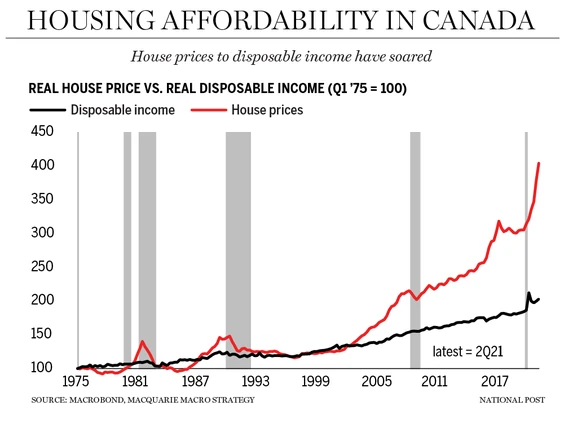
I don't share these numbers to scare you. I share them as a reality check.
Buying a home is no longer something you can simply stumble into. If you want to become a homeowner before the average age of a first-time homebuyer in Ontario, which is now around 40, you need to have a plan. And while earning more money will certainly help, relying on your income to eventually make a home affordable isn't much of a strategy on its own.
There's a good chance if you're reading this, you're young - likely in your 20s or early 30s. No matter which you are, now is the time to take action. The more time you have to plan, save, invest and make smart financial decisions, the more options you'll have when it eventually comes time to buy.
More importantly, having a plan can help you buy a home that you can comfortably afford, rather than simply stretching yourself to the maximum amount a lender is willing to give you.
That's the goal of this article: to give you actionable insights you can use today to start making tangible progress toward buying a home.
And if you're already saving, I'll walk you through how much house you can actually afford - not just what a mortgage broker tells you that you qualify for - and how to determine the right down payment for your situation.
Saving For Your Home
First Home Savings Account (FHSA)
The FHSA is one of the newer investment accounts in Canada and, in many ways, combines the best features of a TFSA and an RRSP.
Your investments can grow tax-free inside the account, and as long as you follow the rules for a qualifying home purchase, withdrawals are also completely tax-free. You can contribute up to $8,000 per year, with a lifetime contribution limit of $40,000.
The other major benefit is that, like an RRSP, your contributions are tax-deductible. In other words, contributing to an FHSA can reduce your taxable income for the year while allowing your investments to grow tax-free.
Even if you're not planning to buy a home anytime soon, there's still a good reason to open one early. Once opened, an FHSA can generally remain open for up to 15 years. So, if you're 20 years old and have no idea when you'll buy a home, opening the account now can still be valuable. You don't necessarily need to contribute a large amount right away, you're just getting the clock started and giving yourself more time to take advantage of the account.
Home Buyers' Plan (HBP)
The HBP isn't a standalone account like a FHSA, but rather is a feature of your RRSP. If you're a first-time homebuyer, the HBP allows you to withdraw up to $60,000 from your RRSP to put toward the purchase of a qualifying home without having to include the withdrawal in your taxable income.
Normally, withdrawing money from an RRSP would create a taxable withdrawal, and you'd permanently lose that contribution room. The HBP gives you an exception to both of those rules.
There is, however, a catch: you have to repay the amount you withdraw under the HBP over a 15-year repayment period. You'll need to repay at least 1/15th of the amount each year.
Personally, I don't view this as much of a downside. You should ideally continue contributing to your RRSP after buying your home anyway, and the HBP simply allows you to temporarily access some of those savings to help get you into the market sooner.
These accounts, when planned properly, give you the opportunity to cover a significant part, if not all, of your down payment. For reasons I'll get into later, you should aim for at least a 20% down payment. Here is an example to demonstrate how I would prioritize these accounts.
Using Them Together
Josh is currently 24 years old and wants to buy a house in 10 years. His take-home pay is $75,000, 25% of which he will save. His budget for the house is $450,000 and he wants to put down a 20% down payment, or $90,000.
Based on his savings rate, he will allocate approximately $1,560 across his FHSA, RRSP, and TFSA. Now, since the sole objective of the FHSA is to buy a house, he will prioritize that to ensure he contributes the full $40,000 maximum. Therefore, to max out his FHSA over 10 years, he must contribute about $330 per month.
Next, for the purpose of using HBP and to gain an even greater tax benefit, he will focus on his RRSP. Josh believes he will earn more later in his career as he's still young, so he won't max out his annual contribution room so he has more room to contribute when the opportunity for a greater tax break arises. For now, he will contribute $670 per month to his RRSP.
Finally, Josh will contribute the remaining $560 to his TFSA. Because withdrawals are never taxed from a TFSA, Josh is planning to not touch any money within this account until after he is retired. However, if he falls slightly short of his $100,000 down payment goal, he has the flexibility to use some of his TFSA savings to make up the difference.
10 years go by and Josh is ready to purchase his house. Assuming a 6% rate of return, the approximate values of each account will be:
FHSA: $54,209
RRSP: $110,060
TFSA: $91,991
Luckily for Josh, he has enough to cover his down payment through his FHSA and HBP. He withdraws the full value of his FHSA and the remaining $35,791 from his HBP. Both are withdrawn in full, and a mortgage is used to cover the other $360,000.
In short, if you're saving for a home, prioritize your FHSA first. If you're able to max out your FHSA, I'd look to the RRSP next, particularly if you're in a higher tax bracket or expect your income to increase substantially over time. You can then use the HBP to access some of those RRSP savings when you purchase your home.
After that, continue contributing to your TFSA so you're still building wealth for your other long-term goals, particularly retirement.
What Should Be My Down Payment?
Your down payment plays a major role in determining how much you'll need to borrow, and ultimately, how much your home will cost you each month. You are required to make a minimum down payment of 5% of the purchase price on houses below $500,000. On houses over $500,000, the required down payment is 5% on the first $500,000 and 10% on the remainder.
But just because you can buy a home with as little as 5% down doesn't mean you should.
As I mentioned earlier, in most cases, I would recommend waiting until you can put down 20% of the purchase price. There are a few reasons why.
1. You Avoid Mortgage Default Insurance
If you put less than 20% down, you'll generally need mortgage default insurance. The premium is based on the size of your down payment and is typically added to your mortgage if you choose to finance it.
For example, if you were to purchase a $550,000 home with a 10% down payment, the total default insurance premium will be approximately $15,000 is added to your total mortgage balance. Over a 25-year amortization period and 4.9% interest rate, purely from the insurance you will end up paying $25,800 more. In most cases, especially for first-time buyers, you would be much better off saving for a couple years to reach that 20% mark.
2. Your Monthly Payments Will be Lower
This is a given, but consider that many people end up putting around 30% of their income towards housing costs. Between your house and vehicle costs, most people have already spent 50% of their monthly income. This makes it very difficult to accumulate wealth.
Let's use the same $550,000 purchase price as above with the same amortization schedule and interest rate. With a 10% down payment, your monthly payments come out to about $2,935 per month. Compare that to a 20% down payment, you're paying $2,530. In today's dollars, even after accounting for the $55,000 extra you put down, you're paying $66,500 more over the life of your mortgage by opting for a 10% down payment
If you're a first-time buyer, there's a good chance you're still relatively early in your career. Your life could look completely different 10 years from now. You might want to start a family, change careers, move to a different city, start a business or simply have more flexibility to enjoy your money. You don't want a massive mortgage payment dictating every financial decision you make.
The less of your monthly income that has to go toward your mortgage, the more you can put toward retirement, investments, travel, starting a family or whatever else matters to you.
And remember, money invested in your 20s and 30s has decades to compound.
3. Greater Flexibility to Refinance Later
A final benefit that doesn't get talked about as much is having more equity in your home can give you greater flexibility if circumstances change.
Typically, in order to refinance you must have 20% equity in your home. For example, imagine you buy a home when mortgage rates are relatively high and rates fall significantly a few years later.
If you only put 5% or 10% down, you may not have enough equity to qualify for a conventional refinance, meaning you could be forced to wait until your mortgage term ends before taking advantage of lower rates.
If you put the 20% down right away, in most cases it gives you the flexibility to refinance anytime. Of course, refinancing before the end of your mortgage term can still come with penalties, so it isn't automatically worth doing just because rates have fallen. You'd need to compare the savings from the lower rate against the cost of breaking your existing mortgage. Still, having the option is valuable.
Don't Be House Poor
When you start seriously looking to buy a home, one of the first people you'll probably speak with is a mortgage broker. They'll look at your household income, outstanding debts, down payment and other financial information to determine how much you can borrow.
But this is the important part: just because they say you can afford it, doesn't mean you can afford it comfortably.
Mortgage lenders are primarily concerned with whether you can service the debt. They're not necessarily looking at whether you'll have enough money left over to invest, start a family, build an emergency fund or simply enjoy your life.
Generally, mortgage professionals use two main ratios when determining how much they're willing to lend:
-
Your housing costs shouldn't exceed 32% of your gross income. Housing costs include mortgage principal and interest, taxes, heating expenses, and half of your condo fees (if applicable).
-
Your total debt - including housing, cars, credit cards, and lines of credit - shouldn't be more than 40% of your gross income.
These guidelines are useful for determining whether you can qualify for a mortgage. But let's look at what happens when you actually live with one.
Matt and Andrea are looking to buy their first home, so they meet with a mortgage broker to figure out how much they can afford. Together, they earn $150,000 per year - $75,000 each - and have up to $120,000 available for a down payment. Their current monthly expenses, excluding rent, are approximately $2,100. They also have two car loans. Both have $25,000 remaining and will be paid off over the next four years. Finally, they mention that they're hoping to have a child within the next year or two.
After running their numbers through some of the major banks' online mortgage affordability calculators, they come up with a "comfortable" home purchase price of around $570,000, which would leave them with a mortgage of approximately $450,000. Let's break this down and see if it really is comfortable.
Their combined take-home income is approximately $9,500 per month. Assuming a 25-year amortization and a 4.9% interest rate, their $450,000 mortgage would cost roughly $2,600 per month. Their two car loans, both at 4% interest, cost another $1,080 per month combined. Finally, let's assume their other monthly expenses - groceries, utilities, phone bills, entertainment and everything else they're currently spending - remain at $2,100.
That brings their monthly expenses to approximately $5,780, leaving them with roughly $3,720 each month.
After adding everything up, their total monthly outflows come out to $5,780. Not bad right? They still have about 40% of their take-home income left over for savings, emergencies and discretionary spending. But we're missing a few things.
What about property tax? A quick google search told me a house worth $570,000 in Windsor would pay taxes of around $12,000 annually, or $1,000 monthly.
Now they're down to roughly $2,720 of monthly cash flow.
Then what about their plans to start a family? The initial expenses (a crib, stroller, car seat, nursery furniture and everything else that comes with a new baby) can easily run into the thousands. But the bigger issue is the recurring costs. Food, diapers, clothing, childcare and other expenses can add up quickly. Let's conservatively say the child adds another $1,000 per month to their expenses.
Suddenly, Matt and Andrea are spending approximately 82% of their take-home income before putting anything toward retirement, building an emergency fund or spending money on the things they actually enjoy. And that's where things can start to go sideways, and how the "house poor" trap begins.
This Is How You Become House Poor
So after putting 82% of their pay purely towards necessities, they have 18% remaining to allocate somewhere. Do you think they will invest it? Build an emergency fund? Unlikely. Instead they will probably put it towards their wants which have suddenly vanished.
Remember that Matt and Andrea used to have plenty of disposable income. They travelled regularly, ate out and enjoyed having the freedom to spend some of their money after taking care of their savings. Now, they've bought a house, have two car payments and have a child. Do you think they're suddenly going to be comfortable eliminating all of those discretionary expenses?
Some people will. But in my experience, most people aren't able to drastically change their lifestyle overnight, and instead will manipulate their cash flow to be able to afford those wants they've become accustomed to.
Another thing, very often the purchase price isn't the end of the story. About 80-90% of new homeowners perform some form of renovation after purchasing their home. Matt and Andrea will already be stretched pretty thin so, as most people do, they will start to accumulate a large balance on their line of credit.
And just like that, they've become house poor. They have too much money tied up in their house and other debts. They are left with barely anything leftover to save and have sacrificed much of the lifestyle they've grown used to. A huge amount of financial flexibility has been lost on a home that, more likely than not, won't even be on their forever home. I don't consider that financial success.
All of this to say - don't stretch yourself on a house. Buying a home, especially your first one, is an emotional experience, and emotions can lead to impulsive decisions. What you present to your mortgage broker today is merely a snapshot of your life and you have to try to keep the big picture in mind. Consider your goals and how much your life can change over the next 5 or 10 years and ask yourself if buying a home right now might hinder that.
My recommendation, if you're truly looking to build wealth, keep your housing costs to no more than 20% of your take-home pay. We all want to buy a house someday, but even more importantly, we want to build the life we actually want.
There's a lot that goes into buying a home, and there's no question that today's buyers - particularly those in their 20s and 30s - are facing a tougher road than previous generations.
But that doesn't mean homeownership is out of reach. It just means you need to be more intentional about how you get there.
If you're in your 20s and still at least five years away from buying a home, my advice is simply to start now. Take advantage of the government programs I outlined earlier, and if you're living at home and your expenses are relatively low, I'd aim for at least a 25-30% savings rate.
If you're in your 30s and hoping to buy in the near future, don't let the pressure to become a homeowner push you into a decision you're not financially ready for.
Renting is not a failure. In fact, sometimes it's the smarter financial decision. Your landlord gets to deal with the broken furnace, leaky roof and other headaches that come with owning a home. But more importantly, renting gives you flexibility while you figure out what you actually want your life to look like.
Your first home probably won't be your forever home. You may change careers, start a family, move cities or simply discover that your priorities are different five years from now than they are today. Giving yourself breathing room to keep those doors open.
As a final note, I want to remind you everything in this article is general advice and won't apply to everyone. We all live different lives, deal with different obstacles, and have different long-term goals. If you're seeking clarity on your path to buying a home, or want personalized advice on whether or not buying a home right now is the best decision for you right now, I encourage you to reach out.
Home buying has never been more stressful than now. Our job is to take some of that pressure off your shoulders, help you understand your options and give you a clear, actionable path toward one of the biggest milestones of your financial life.