If I was 23 (my current age) 30 years ago, I probably wouldn't have been a financial advisor.
I would've been a travel agent.
Learning about the world has always been a huge passion of mine, honestly, just as much as I love finance. I would spend hours just looking at maps, then when I found a place that interested me, I'd research all about their culture, history, and way of life (this is especially fun for those super obscure islands in the Pacific. I recently watched a whole documentary about the Pitcairn Islands). I'd even plan out full itineraries of what I'd do in each country I scoured.
Today I do literally all the trip planning for my family and even some friends. Flights, hotels, interesting things to do and see. It feels like a big puzzle you have to put together and often lose track of time and spend hours doing it. Even still have a bunch of travel books sitting around that I'd always read.
All this to say - I love to travel, and if it were up to me I'd be writing this post while I'm on a safari in the Serengeti.
But, as I'm sure many of my other travel lovers have realized, it can be pretty expensive. Being that I'm a financial advisor, you'd probably expect me to suggest that you don't spend money on trips, but that isn't the case at all. I'm a big believer that memories are significantly more worth the money than material items. You see a new pair of shoes you want and you convince yourself you can't leave without them, no matter the price. Two months later, that excitement of owning those shoes are long gone. With memories though, those feelings you felt experiencing them never fade.
With that being said, if you wish to travel extensively, you will have to find ways to lower costs. Every trip can't consist of 5-star hotels and fine dining each day.
But here's the great thing, in my experience I've found that lowering costs when travelling forces you to be more adventurous, and the more adventurous the trip, the more memorable it will be.
Of course, I will keep everything in reason, as well as offer suggestions as to saving money for those who do enjoy the pricier style of travelling. As you'll see here shortly, most of what you can do to budget effectively for your trip happens much before your flight even takes off.
P.S. A fantastic way to save money while travelling is through your credit card perks. I've decided to not cover this for this article, since an entire rabbit hole we could get into and would probably be about the entire length of this article if covered in-depth. Not to mention, when choosing a credit card, a lot more should be taken into consideration than just it's perks. So if you go through the article and wonder why that's not included - there's your answer.
Before the Trip
Use a Sinking Fund
One thing I always do months before any trip is setup what's called a "sinking fund". Essentially it's just a separate account where you set aside a bit of money each month to save up for something, like a car, holidays (especially Christmas), or in this case, a trip. Open a high-interest savings account, figure out what you're comfortably able to spend on a trip, and set aside a bit of money each month. The great thing about this is when it comes time for you to actually pay for the trip, all the money is set aside in a different account and it's entire purpose is just to fund the trip.
If you have Wealthsimple, for example, you can set it up just like you would any other savings account where you pay yourself first. Pick a certain date each month for the money to come out of your account before you have a chance to spend it elsewhere.
Another important benefit of doing this is it gives you a budget of what you can spend on your trip. If you have a fixed amount set aside for the sole purpose of your trip, you can easily track how much you're spending each day. A much better option that just throwing everything on your credit card and getting a rude awakening on your next statement.
Choosing Your Flight
This is honestly one of my favourite parts of the planning process because if you are willing to be a bit flexible, there are so many ways you can save money on your flights. For most people, this process probably looks something like this:
Search "flights" in Google, click on the first booking link that pops up, enter in your destination and travel dates, see what pops up, repeat the same for 3 or 4 other sites, then book the cheapest one.
It's fair enough, I know a lot of people don't enjoy this part of the booking process. However, with a little outside the box thinking, I guarantee you can do better. And the best part? It can take as little as 15 minutes. Let me explain using an example.
In our example, we are going to be looking for flights from Detroit (the closest airport to me) to Hawaii. The dates we'll use is September 14-21st, but will be slightly flexible. You'll find that the more flexible you are with your travel dates, the more you're able to save.
The first site I'd suggest using is Google Flights, specifically the 'Explore' tab. This is an especially great site if you're just looking to travel somewhere without a specific place in mind. You can put in flexible or specific dates and drag around the map to see prices from your selected airport on those days. Here are the prices in the case of our example.
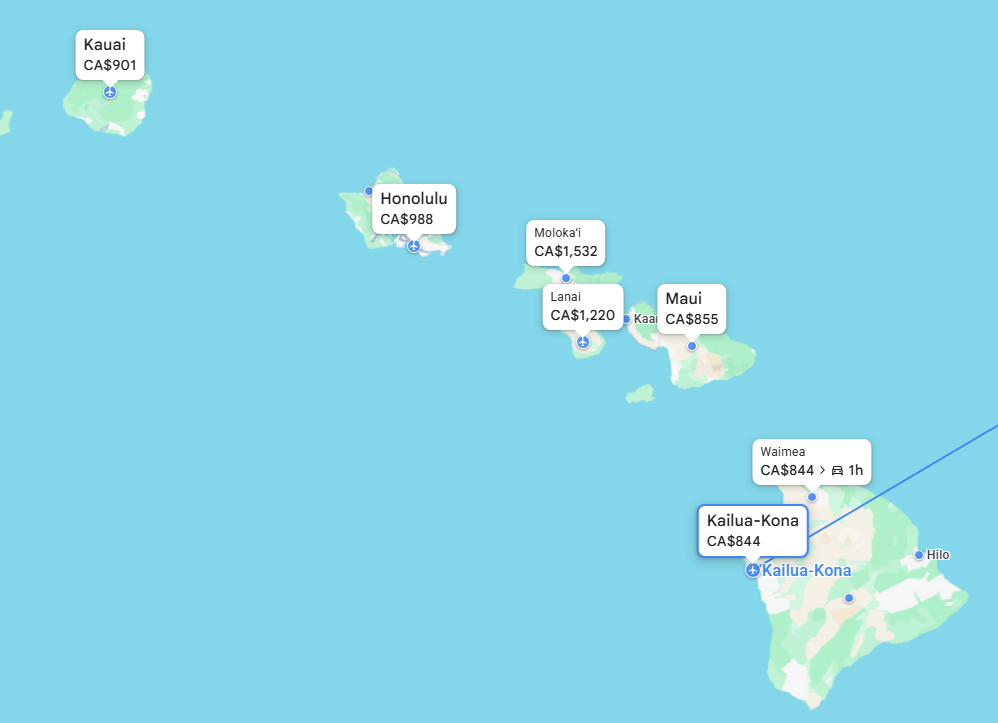
As you can see, the cheapest airport to fly into in Hawaii during these dates is Kailua-Kona. If you're looking to travel to multiple islands, travel within the islands tends to be much cheaper, so being flexible with where you arrive will save you money here.
Next, I'd go to ITA Matrix. Best part about this site is you can search for flights from and to multiple different airports on various dates, all in one search. To show you what I mean, take a look at the photo below. In this search, I was able to include the 4 cheapest airports to fly into from Detroit on our dates of September 14-21. Look next to the outbound and return date and you'll also see it says +/- 2 days. This means it will search for flights to these airports as early as September 12th and return flights as late as the 23rd.
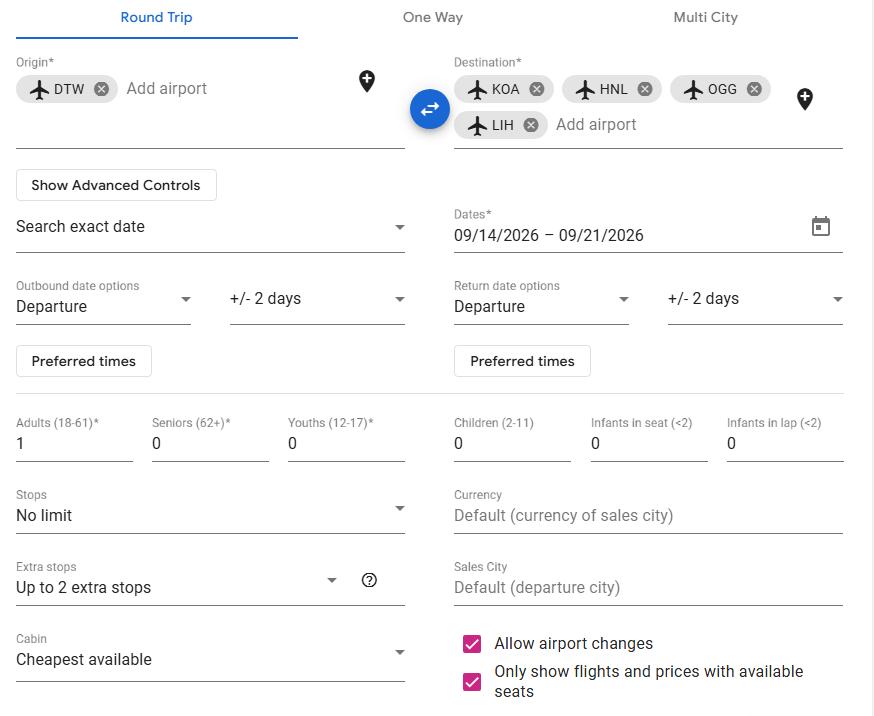
After our search, we can see that is actually cheaper to leave the 15th and return the 22nd. Note that the $562 listed is in USD, but this comes out to approximately $780 CAD - so $64 per traveller cheaper for the exact same length of trip, leaving and returning just one day earlier.

The last site I'd go to is Skiplagged. I consistently find the cheapest flights on any given date here. Once I determine the best dates to fly and the cheapest airport to fly into, I throw that into Skiplagged and will always almost get at the minimum, decent savings. So, for our flight from DTW to KOA on the 15th to the 22nd, lets see what we get.

$525 USD, the equivalent of about $729 CAD. That's how easy it is. With a couple google searches, we found flights $115 cheaper per traveller. Now imagine if you're flying somewhere that isn't an island and you'd be okay flying somewhere nearby then driving or taking a train to your final destination, you could save even more.
One last note on this, packing light will also save you a ton. Often you may see a discount airline offering the lowest fare, but their baggage fees are ridiculous. If you pack heavy on a discount airline, you'd probably be better off flying with a non-discount airline. Take a look at Frontier's baggage fees, for example:
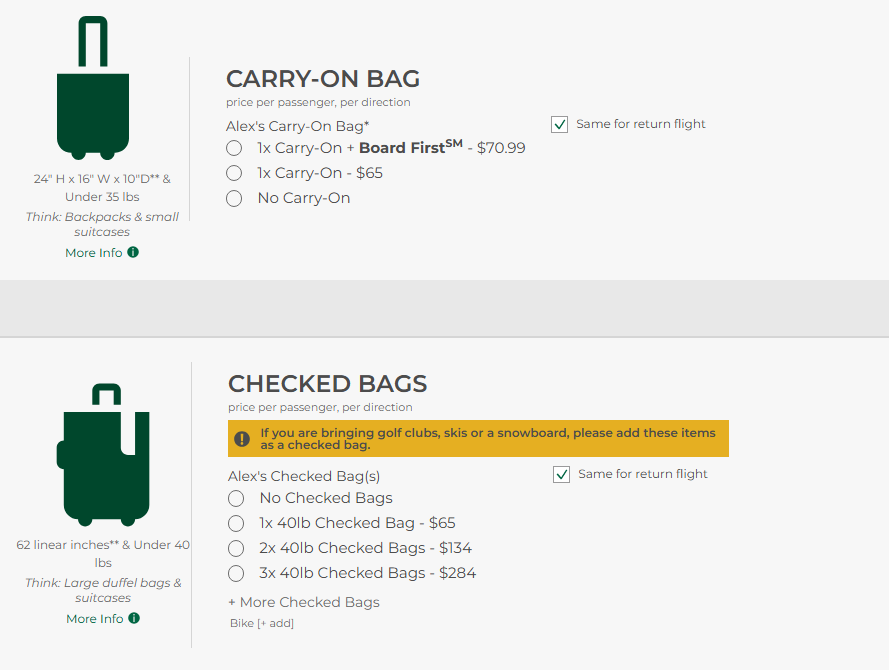
Notice how it says "price per passenger, per direction"? So if you wanted to just bring one carry-on and one checked bag, it would add $260 USD to the price of your flight! Try to pack light or if you can't, just be aware of this.
Finding Accommodations
How effective this section will be for you depends on how adventurous you're willing to be. Nothing crazy, but if you are willing to move away from the 5-star hotels you'll find there are tons of opportunities to save money.
For longer trips - anything two weeks or longer - I would highly recommend using Airbnb or a similar site and rent a place out. It's also a much better option if you're going with a bigger group of people. In almost every case you're able to find accommodation that is cheaper per night than hotels. What I love to do, especially for travel within North America, is rent out a place a bit further away from the touristy or downtown areas and rent a car. You can find really nice places if you're willing to drive just 20 minutes, but for me I like the driving part of it since it gives you more opportunities to explore the area.
Another good option when it comes to accommodations is looking into hostels. Of course, you should do research beforehand to make sure where you're staying is safe, but for travel in Europe and Asia this is a great option to stay right in the heart of where you're travelling for a much cheaper price. I helped my sister book a trip to Denmark and France last year with her friends and found her hostels in each place she stayed - she saved over $400 throughout the course of her trip not staying in hotels.
Plan Your Itinerary
One thing I've always found when I travel is the less planning I do, the more I tend to spend. I think the main reason for this is it's a lot easier to opt for convenience without a set plan. If you're in a touristy area and are just winging it for what you want to do, you're a lot more likely to end up at the popular tourists spots and restaurants which also means more $$$.
I don't mean to say you should plan out every second of every day, I think spontaneity makes for a more exciting trip. But I'd highly recommend creating at the least a light structure for each day, including what area you want to explore that given day and what you're going to eat.
During the Trip
Although most of the work to save money happens before you leave, there are still things you can do to save money while you're at your destination. Here are some of the big ones.
Buy Groceries
This is a big one. Very often on trips, especially extended ones, can costs on food and restaurants become the most expensive part of a trip. Not to say you shouldn't go to restaurants and explore the cuisine, but I like to just buy groceries for breakfast, then skip lunch and buy snacks instead. You can imagine how quickly restaurant costs will add up over longer trips going 3 times a day, especially on those longer trips. It's also important to remember you'll likely be in a touristy area so this alone will make restaurant meals more expensive than you may expect.
Speaking of restaurants, I'd highly suggest limiting the amount of alcohol you order, and buy it at the store instead.
Day Passes
This one more relates to if you're considering staying at a fancy resort. Often, you can buy day passes to these resorts to use the amenities. You can easily save hundreds, maybe even thousands doing this. Remember, you're on a trip so more likely than not, your room will just be a place to sleep. Cutting costs to stay in a cheaper place then spending your day at a fancy resort will make you feel like you're at that luxurious resort anyways.
Avoid Tours
This is one thing you'll never see me doing. Day tours offered are usually pretty expensive and I honestly don't see the value in it, especially in a time where we have the internet. I think it's so much better exploring yourself and you'll probably have a better time doing it too. This ties back into the planning part we talked about earlier - if you've planned out your trip, done your research, and know what you want to see, why pay so much extra for a tour guide?
I know this article has been a bit different from what I usually put out, but I know a lot of you also in your 20s and 30s love to travel so I hope you were able to find value in some of these tips and put them to use on your next getaway. Of course, there are hundreds of ways more out there to save money and some may be specific to a certain place, so spend some time researching where you're going beforehand and don't just wing everything.
As a final note, I want you to think back to the favourite trips you've gone in throughout your life. What do you remember most from them? I'd bet almost none of you said the fancy room you stayed in or the overpriced meals you had at tourist overrun restaurants. It's the experiences you have while you're there - exploring the area and culture, doing something fun, or just being able to take it all in with your friends or family. Keep that in mind next time you're thinking about spending $500 more per ticket on a nonstop flight or booking a luxury resort - save on all the bells and whistles so you can spend more on the experience and activities.