
If this is your first time checking out one of my articles or have no idea what I do, allow me to briefly introduce myself:
My name is Alex Lejeune, and I'm a Financial Advisor.
Before you click off this article because you think "he literally IS a financial advisor, obviously he'll say you need one!" Don't click away just yet.
Yes, I’m obviously going to advocate for the value of financial advice when I believe it can genuinely benefit someone. But I’m not writing this article to convince you that everyone needs an advisor. In fact, I think there are plenty of situations where hiring one may not make sense.
My goal with this article is to be as objective as possible and give you the information you need to decide for yourself whether working with a financial advisor is right for you.
Before we get started though, I've been seeing across social media and the internet as a whole an increasing number of misconceptions about what a financial advisor actually is and what we do. Straight off the Canadian government's website, here is how they define a financial advisor:
"A financial advisor is a professional who helps you manage your money, make investments, and plan for your financial goals."
A bit vague, for sure, but this is a good start to understanding what an advisor does at a high-level. For a more detailed description of services, you can check out my services here.
I also want to address a few common myths about financial advisors that I frequently see online. Clearing these up first will help us have a more productive conversation when we weigh the actual pros and cons of hiring one.
Myth #1: The only thing Financial Advisors do are pick investments
I saw a tweet a couple weeks ago that went pretty viral essentially claiming this, which is entirely false.
In reality, investing is just one piece of what we do.
Think of your finances as a pie. There are several different pieces that make up your overall financial picture: budgeting and cash flow, tax planning, estate planning, insurance, financial planning, retirement planning, and, if you’re a business owner, business succession planning.
While I obviously can’t speak for every advisor or firm, my role and the role of our firm goes far beyond simply selecting investments. We look at how the different pieces fit together and how decisions in one area can affect another.
For example, choosing how much to invest in an RRSP isn’t just an investment decision. It can also have tax implications, affect your retirement income, and ultimately influence your estate plan. Similarly, determining how much life or disability insurance you need isn’t something that can be looked at in isolation from your income, debts, family, and long-term goals.
In terms of mainly using an advisor for investments, I will dive deeper into this discussion later on.
Myth #2: Advisors are only for the wealthy
Part of this is true. Some advisory firms do require a minimum amount of assets in order to work with them. However, that is not all advisors.
A main reason I focus on working with 20 and 30 year olds is because what you do with your money early in your career will be the biggest factor in determining if and when you will reach financial freedom. Schools do nothing to teach you about this stuff and I truly believe that's a big reason so many Canadians are experiencing financial struggles today.
I always say: the biggest indicator of what your net worth will be at 55 is what you did with your money during your 20s and 30s.
Myth #3: I can just DIY everything
Sure, you could, and for some people perhaps they would be better off doing it all themselves. But for some people, trying to manage everything themselves can lead to missed opportunities, costly mistakes, unnecessary stress, or simply spending more time thinking about their finances than they need to.
Deciding which one you are is what this article is all about, so let's get into it!
The Argument Against Hiring an Advisor
Reason #1: Your finances are simple
This is probably the main reason for a lot of people to choose not to hire an advisor. And while I do agree that could be true, I want to play a bit of devil's advocate here as well.
Let's start with what I agree with. Undoubtedly, there's situations and tasks where you don't need an advisor. Take someone in their teens who is working part-time at a minimum-wage job. Their financial priorities are relatively simple: keep track of where their money is going, avoid spending more than they earn, build some savings, and perhaps start investing for the long term.
The same could be said for a university or college student who isn’t working. You may have student loans to manage, but for the most part, the focus is simply on being responsible with the money you have.
Generally speaking, if you’re a responsible saver and spender, have a good understanding of investing, and are investing for the long term without particularly complex financial goals, you probably don’t need an advisor.
But one misconception I see a lot is this whole generalization that young people usually have simple finances which means they don't need an advisor. This isn't true for a few reasons.
When it comes to investing, I often see young investors take the approach of “VFV and chill", or something similar. For those unfamiliar, VFV is an ETF that tracks the S&P 500. There’s nothing inherently wrong with investing in an index fund, but buying one fund because it’s popular on social media isn’t necessarily the same thing as having a well-thought-out investment strategy.
Investing is easy when markets are going up. The real test comes when they aren’t. Understanding what you own, why you own it, how diversified you are, and what you should do when markets fall can make a significant difference over decades of investing.
Secondly, there’s value in being proactive, even when your finances are relatively simple.
Schools generally don’t teach us how to manage money, so many people enter adulthood without a clear understanding of budgeting, saving, investing, taxes, or financial planning. Building good habits early can put you in a much stronger financial position years down the road.
Finally, your finances may be simple today, but you may still have meaningful financial goals. If you’re saving for your first home, for example, an advisor can help you determine how much you need to save, how long it may take to get there, and which strategies could help you reach that goal while still balancing your other financial priorities.
So, if your finances are simple and you’re confident in what you’re doing, there’s absolutely nothing wrong with taking the DIY approach. But if you're not, is it really worth paying 1% more of your investments for financial decisions that could cost you thousands?
Reason #2: You genuinely enjoy managing your own finances
This one is pretty straightforward, but if you enjoy looking after your finances yourself, then more power to you!
You've probably heard the saying, "you make time for the things you want" and I think that rings true here. If you genuinely enjoy looking after your investments, budgeting, tax planning, and your financial plan as a whole, and you feel confident doing so, you naturally will make time for it and do a better job than someone who dreads it.
That said, as your finances become more complex, it can still be worthwhile to get a second opinion or seek specialized advice. You don’t necessarily need an ongoing relationship with an advisor; even a fee-only advisor can help you identify blind spots, review your plan, or answer specific questions.
But if you enjoy managing your own finances, feel confident doing so, and don’t have an overly complex financial situation, you probably don’t need ongoing advice from an advisor.
Reason #3: You are both frugal and organized
My grandad was a lot like this. He never had an advisor and I could understand why.
I've seriously never met someone more organized than him. He had a huge black book where he literally kept track of everything. I'm talking when he would fertilize and mow the lawn, wrote down and dated every transaction he'd make, notes about where he kept all his important documents. It was pretty remarkable.
You could imagine how he was with his finances then.
He never made more than $70,000 a year - which, to be fair, was quite a bit back then - while my grandma never worked and they were raising two kids. They owned one car, he carpooled to work three times a week to save on gas, and rarely ate out.
I could go on but you get the point. He had no need for an advisor because he was intentional with everything he did and understood the importance of saving. He built his lifestyle in a way where he was always thinking about how his actions today could impact the future.
To be clear, I’m not saying you need to be as frugal as my grandad to take the DIY approach. But I do think it takes a certain level of financial responsibility and organization to manage your finances effectively without professional help.
You need to be able to look at the big picture, understand your priorities, set clear short and long-term goals, and actually follow through on them. If you struggle with spending, staying organized, or consistently saving, managing everything yourself can become much more difficult.
Honestly though, if you're someone like my grandad, you don't need an advisor and genuinely I admire you. You are one of the few not overtaken by constant consumption and understand how what you do today can impact you years from now. So well done.
The Argument For Hiring an Advisor
Reason #1: People with advisors earn better returns than those without
It's funny how one of the myths about financial advisors I pointed out at the start of the article was how we don't just focus on investments and my first argument for hiring an advisor is about investments - but it has to be pointed out.
We are living in a time where it is so cheap to trade. The average fee on a passive ETF is 0.4%, which is remarkable, and I'll tell you right now if you do hire an advisor you will pay more in fees than that (likely between 1-2%).
Yet, even taking fees into account, studies by Fidelity show that on average, those who work with an advisor add about 3% to their returns than those who don't. That 3% doesn't come from fund selection. It comes from rebalancing and having someone to hold you accountable.
People are emotional and people hate to lose money. As soon as there are market downturns, for most investors, all rationality goes out the window. In "Your Money & Your Brain" by Jason Zweig, he found that financial losses are processed in the same area of the brain that responds to mortal danger. When you take that into consideration, you can understand why people are okay with suddenly buying high and selling low.
In reality though, this is the worst possible thing you could do. Just take a look at this graph below which shows the difference in your returns if you stay invested, or if you panic sell or try and time the market and miss the best days.
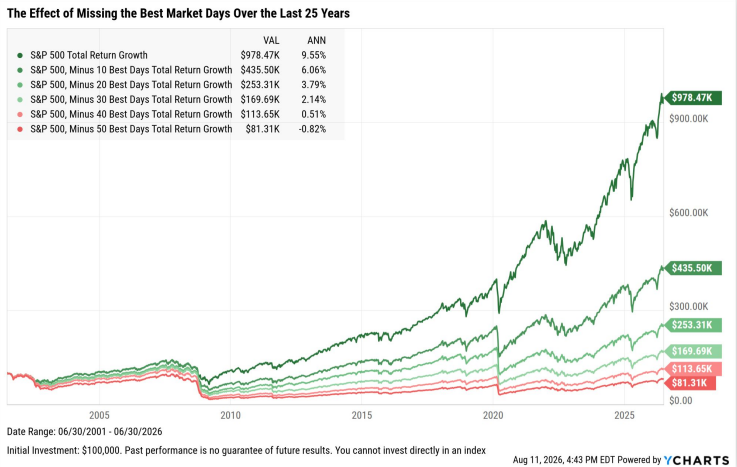
It makes a difference of hundreds of thousands of dollars. But that's where advisors come in to help you take a step back and stop you from making an impulsive decision.
If you're a new investor, you might think "Oh I can do that no problem, I'm not impulsive at all!" Problem is, you've never been in it. It's impossible to know how you'll react when all you've known the markets to be are sunshine and rainbows. If we are hit with another 2008 and your $100,000 portfolio drops to $70,000 while all you hear around you is constant noise and panic, will you be able to stop yourself from making that impulsive decision? Think about it.
Oh, and one more thing. That 3% number I mentioned earlier? That was on investments alone. Then, on top of that, factor in implementing tax-efficient strategies, proper retirement drawdown strategies, and coaching. So really, your returns are much higher than 3%, everything considered.
Reason #2: Most Wealthy People Have an Advisor
Here's an interesting stat. A 2025 study done by Northwestern Mutual found that 74% of millionaires have a financial advisor. Let's compare that to the percentage of the general population that has one.
34%.
That doesn’t mean hiring an advisor will make you wealthy. But I do think there are a few reasons why wealthy people tend to recognize the value of financial advice more than the general population.
First, their financial situations tend to be be more complex. As your wealth grows, so does the number of financial decisions you have to make. Tax planning becomes more important, you may have multiple investment accounts or different types of assets, and you may own a business or have other sources of income. You might also have more unique circumstances to consider, such as being self-employed, a dual citizen, or having significant assets tied up in a business.
When your financial situation becomes more complicated, having someone who can help coordinate all of those moving pieces can become much more valuable.
Second, they understand the importance of their time and want to delegate tasks. Imagine you’re a business owner who spends 10 hours a day running and growing your company. Do you really want to spend your evenings reviewing spreadsheets, researching investments, and trying to figure out the most tax-efficient way to structure your finances?
Probably not. At a certain point, paying someone to handle something you could do yourself becomes less about whether you’re capable of doing it and more about whether it’s the best use of your time.
Third, they understand the value of spending for expertise. There’s a reason wealthy people pay accountants, lawyers, business consultants, coaches, and other professionals. They understand that expertise has a cost, but that cost can be worthwhile if it helps them make better decisions or avoid expensive mistakes.
I’m certainly not a millionaire, but I personally spend $300 a month on coaching because I believe the value I get from someone with expertise is greater than the cost.
The same principle applies to financial advice. On the surface, hiring an advisor will almost always look more expensive than managing everything yourself. But the comparison isn’t “1% advisor fee vs. 0% DIY.” It’s the cost of advice compared with the potential value of better decisions, better tax strategies, avoiding costly mistakes, staying disciplined, and freeing up your time.
That doesn’t mean an advisor is automatically worth the cost for everyone. But it does support the point that growing, and then maintaining your wealth more often than not is a team effort.
Reason #3: Leaves you free time to do the things you want
Picture this: It’s Friday evening, and you’re finally leaving work two hours later than expected after catching up on everything you didn’t get to during the week. You’re driving home, already planning out a nice evening to unwind.
"I'll make myself a nice dinner, get together with a couple buddies and wat..."
"Oh crap. I have to rebalance my portfolio. I've put off for 3 weeks."
Reality is, most people don't enjoy doing this stuff. It's not exciting, it's time consuming, and might just stress you out more than anything. But it's also not something you can just ignore (it wouldn't be wise to anyways). So, inevitably it forces you to take time away from whatever you really want to do - whether that’s putting more time into your career or side hustle, spending time with your family and friends, working out, or simply relaxing.
This is where advisors can provide values beyond just the financial decisions themselves.
Instead of having to constantly think about your portfolio, financial plan, and whether you’re still on track, you can have a professional help manage these areas with you. As your life changes, they can update your financial plan and projections, help you adjust your strategy, and keep you accountable to the goals you’ve set.
And when it comes to your investments, you don’t have to spend your evenings researching markets, deciding when to rebalance, or wondering whether your portfolio has become too concentrated in a particular sector or asset class.
You’re essentially outsourcing something that you could do yourself, but probably don't particularly want to.
If you're young and have lots of free time you may not see the value in this now. But as life gets busier - kids, a demanding career, a side business, staying active, cooking, maintaining a social life, and everything else that comes with adulthood -managing every aspect of your finances can become another item on an already long to-do list.
So why not opt to spend that time to focus on your career and the things that genuinely matter to you, while having the peace of mind of knowing you're taken care of financially by a professional who genuinely wants to see you succeed?
Sounds like a pretty good trade-off to me.
Reason #4: You get a clear path forward towards your goals
This is my favourite part that comes with being an advisor.
Most people have a very short-term lens when it comes to their finances. They figure out how to make ends meet for the month to cover their bills, set aside a bit for savings, then don't think about it again until next month. If you asked 100 people on the street what their financial goals 10 years from now are, I'd bet 90 of them won't have an answer (or they will give a vague one with no sort of plan to go along with it).
Think about all the uncertainty this creates. Wouldn't it be nice to have actual attainable goals 5, 10, 20, and 40 years from now and a clearly laid out action plan on how you can get there?
Seeing client's faces and reactions when they get this clarity is an incredible thing. Suddenly, that house that they thought was 15 years away, backed by their plan of "save and hope for the best" is no longer the case. Instead, they have a clear timeline of what to do when, a full breakdown of where their money is and should be going, and all while still accommodating their lifestyle.
And all the sudden, with a proper plan in place, they realize they can comfortably afford that house in just 10 years.
It's a fact that money is the greatest life stressor across all Canadians, and much of it is because the future is so unclear. A fluid and collaborative plan eliminates that uncertainty.
Reason #5: You Have Someone to Hold You Accountable
Listen, no one wants to see you succeed more than yourself. But I mean it when I say your advisor will be #2.
When you hire an advisor, what you are getting is a partnership. And what I love most about my work is with my clients our relationship goes deeper than just "how do I manage my money?" What comes from it is something much more real than that.
We are by your side when you buy your first home, when you get married, when you start a family, when you retire, and beyond, and all the ups and downs that come along the way. You put your trust in us, we know you actually care to improve your finances since you took action, and we genuinely want to see you succeed. That's why we hold you accountable.
The easiest analogy here is a personal trainer. Sure, you could DIY your workouts and your diet, but people with personal trainers almost always see better results. Why?
Because they hold you accountable. They make sure you exercise 4-5 times a week. They check in to make sure you're following your diet. And just like an advisor, they want to see you progress and succeed.
How do we hold you accountable? We check-in to make sure you're following what we laid out in your plan and meet at least a couple times a year to go over your progress. When the markets are down, we keep you from making an impulsive, emotional decision that could cost you thousands. We make sure your saving habits don't take a backseat to accommodate wants.
Personally, that's someone I'd want in my corner.
I hope this article has not only helped you make an informed decision on whether or not an advisor is right for you right now, but also cleared up some misconceptions surrounding advisors that have been emerging lately.
While I wholeheartedly agree some people don't need an advisor, to my young people reading this, don't let these two factors cloud your decision, as many do:
A simple financial situation and/or fees that come from working with an advisor.
A simple financial situation, with proper guidance, is the prime time to set yourself up with a strong financial foundation for your future.
In regards to the fees, I hope this article helped illustrate that sometimes, the cheapest option can turn out to be the most expensive one.
Instead, evaluate your current financial situation: your savings rate, your financial goals for the future and your plan to achieve it, your spending habits, and your comfort level with making investment decisions. Then ask yourself, are you happy with where you are and do you believe you're right where you should be? Or is your situation foggy and feel uncertain that you're on the right path?
That's where you will find your answer.
If you're not sure just yet if an advisor is right for you, but are looking for additional resources you can use to be better informed when making money decisions, I encourage you to join my email list. I promise to not spam you, and nearly all will be from client conversations I've had with other young professionals that I believe will be relevant and helpful for you on your wealth-building journey.
As an added bonus, you will also receive a free PDF "7 Financial Moves Everyone Should (and Shouldn't) Make Before 30."
You can register here: https://alexlejeune.ca/
That's all for now, hope to see you again!