As you move through life, you'll realize that your finances become increasingly personal. The way you manage your money, the decisions you make, and even what success looks like financially will depend entirely on your own goals and circumstances.
Take two 55-year-olds, for example. One is married with three kids, recently bought the house they plan to retire in, and is earning the highest income of their career. The other is single, has no children, works remotely, travels several times each month, and rents an apartment because they're rarely home. Do you think those two people have the same retirement goals? The same lifestyle? The same savings strategy?
Of course not. In fact, there's probably very little financial advice you could give one that would also be the best advice for the other. They live completely different lives, so their financial plans should look completely different too.
There is one stage of life, though, where I think there is a piece of financial advice that applies to almost everyone. If you're currently in post-secondary or you've recently graduated, this is for you.
Just start, but be intentional.
If you've paid very little attention to your finances up to this point, this article is for you. If your entire investing strategy consists of putting a little money into the S&P 500 every month and hoping for the best, it's for you too.
The reality is that if you have a steady income, build a realistic plan, and actually stick to it, there's no reason you can't build significant wealth over time.
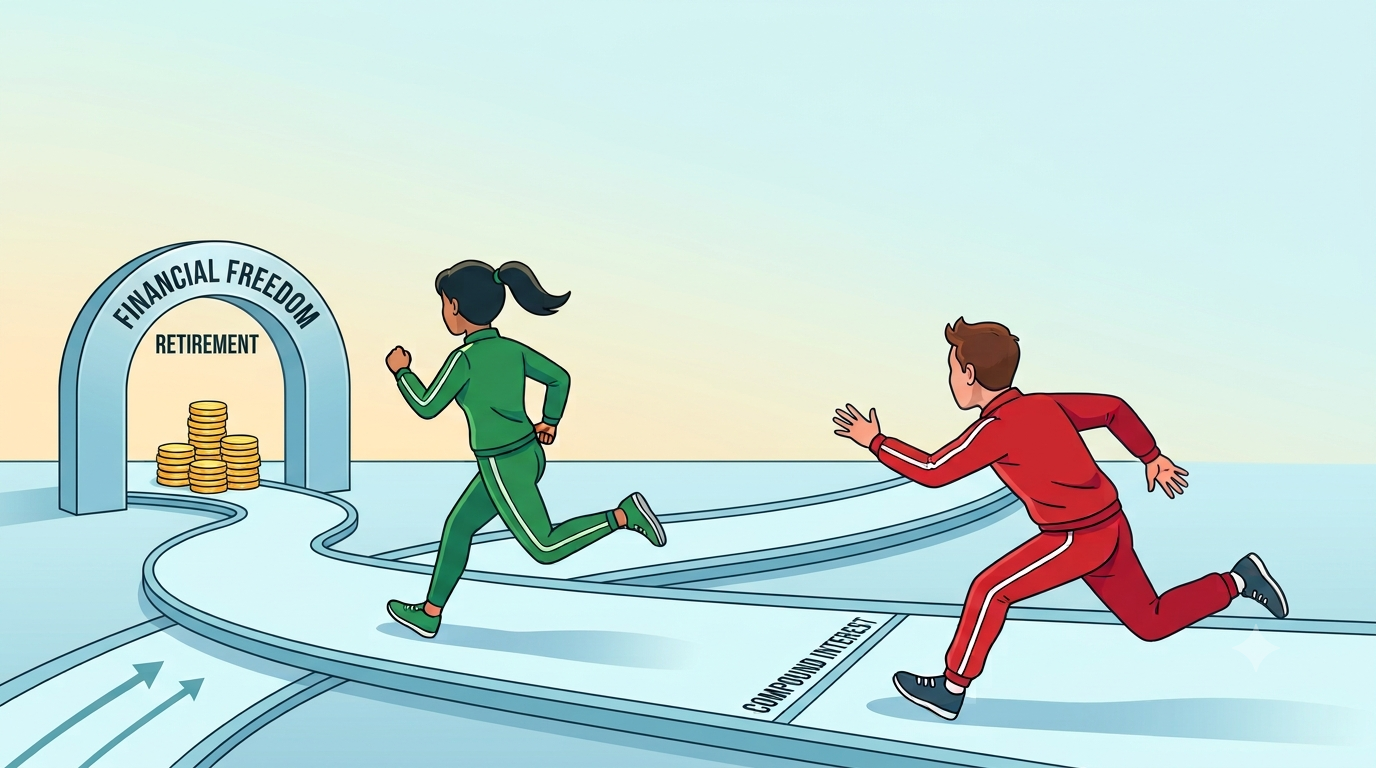
In this article, I want to show you exactly why that's true. More importantly, I want to illustrate just how much of a difference getting started five years earlier can make.
Client Info and Assumptions
Since the goal is to isolate the impact of starting five years later, I've made sure everything else between these two financial plans is identical. The assumptions, income, investment returns, retirement goals, and lifestyle are all the same. I've also set a few criteria that both plans need to meet so we're measuring a comfortable retirement, not one where they're simply scraping by.
If you're curious, all of those assumptions and retirement criteria are outlined in the table below.
Client Info | Assumptions | Retirement Criteria |
|---|---|---|
Both of these clients...
|
|
|
As you'll see, the two clients are almost identical. There are only two differences between them: when they start and the savings rate required to reach the exact same goals.
To make things easier to follow, let's give them names. After an extensive five minutes of thinking, our 25-year-old will be Lisa, while our 30-year-old will be Bart.
Throughout the rest of the article, we'll compare four key parts of their financial plans:
-
The savings rate required to buy a home at age 35
-
The savings rate required to maintain a comfortable retirement
-
The earliest age each client can retire (up to age 55)
-
The value of their investment accounts at retirement
I think that's enough setup. Let's get into the numbers and see just how much of a difference those five years can make.
Home Purchase
Lisa
Lisa just turned 25 and has decided to open three investment accounts: a Tax-Free Savings Account (TFSA), Registered Retirement Savings Plan (RRSP), and First Home Savings Account (FHSA).
Since she's planning to buy a home in 10 years (the shortest goal in her financial plan), she'll prioritize her FHSA first. By contributing consistently each month, she'll reach the FHSA lifetime contribution limit of $40,000.
After that, she'll contribute slightly more to her RRSP than her TFSA for two reasons. First, she plans to use the Home Buyers' Plan (HBP) alongside her FHSA to help fund a 20% down payment of approximately $110,000. The HBP allows first-time homebuyers to withdraw money from their RRSP tax-free, provided it's used toward purchasing a qualifying home.
Second, her income already places her above the lowest tax bracket, meaning RRSP contributions provide an immediate tax deduction while she continues to build retirement savings. Her plan is to leave her TFSA completely untouched until retirement so it can continue growing and eventually provide tax-free withdrawals later in life.
With that strategy in place, her monthly contributions look like this:
-
FHSA: $330/month
-
RRSP: $375/month
-
TFSA: $200/month
The primary objective over the next 10 years is to grow her FHSA and RRSP enough to fully fund a 20% down payment without needing to touch her TFSA.
Speaking of the down payment, you might be wondering why I'm using 20% as the target. Reason being is because putting less than 20% down means you'll have to purchase default mortgage insurance.
Using Lisa's example, a $550,000 home with only a 15% down payment would add roughly $13,000 in insurance premiums to the mortgage. That may not sound like a huge number at first, but because you're also paying interest on that insurance premium, the true cost becomes much larger. Assuming a 25-year amortization and a 4% mortgage rate, that decision would end up costing roughly $60,000 more over the life of the mortgage.
The takeaway here is if it's realistic for your situation, saving a little more upfront to reach a 20% down payment can save you tens of thousands of dollars over time.
Now let's fast-forward to 2036, when Lisa is ready to buy her home.
After 10 years of contributions and investment growth, her accounts have grown to approximately:
FHSA: $53,618
RRSP: $60,929
TFSA: $32,496
Not only has Lisa reached her down payment goal, but she actually has some cushion. She can use her FHSA and RRSP toward the purchase while leaving her TFSA completely untouched to continue compounding for retirement.

She purchases her home with a $440,000 mortgage at a 4% interest rate, resulting in monthly payments of approximately $2,350 over a 25-year amortization.
Total savings rate for Lisa (ages 25-35): 17.24%
Bart
When Bart turns 30, he comes to the same realization Lisa did, just five years later. He opens the exact same three accounts: an FHSA, RRSP, and TFSA.
His priorities don't change either. He'll contribute to his FHSA first, then his RRSP, and finally his TFSA. Like Lisa, he'd also prefer to leave his TFSA untouched until retirement so it has as much time as possible to compound.
To stay on track for buying the same home at age 35, Bart needs to contribute:
-
FHSA: $650/month
-
RRSP: $1,000/month
-
TFSA: $200/month
Five years later, when it's time to purchase the home, his accounts have grown to approximately:
-
FHSA: $46,130
-
RRSP: $68,403
-
TFSA: $13,681
While the combined value of Bart's FHSA and RRSP is enough to cover the down payment, there is one limitation that comes into play. Under the current rules, the maximum amount he can withdraw from his RRSP through the Home Buyers' Plan (HBP) is $60,000.
Because of this, Bart needs to use a portion of his TFSA to make up the remaining $3,870 required to reach his $110,000 down payment.

Total savings rate for Bart (ages 30-35): 35.24%
As you probably expected, Bart only had half as much time to save for the down payment. As a result, he needed to save more than twice as much of his income to reach the exact same goal.
That's already a pretty significant difference, but buying the home is only the first part of the story. Let's see what those same five years do to their retirement plans.
At Retirement
Lisa
After purchasing her home, Lisa adjusts her contribution strategy. As her income continues to increase over time, she decides to place a greater emphasis on her RRSP to take advantage of the tax deferral available to her.
Her new monthly contributions are:
-
RRSP: $850/month
-
TFSA: $470/month
She continues making these contributions until age 55, at which point her accounts have grown to approximately:
-
RRSP: $350,616
-
TFSA: $303,063
Lisa's savings rate from ages 35-55: 20.41%
And just like that, Lisa has reached a point where she can comfortably retire at age 55.
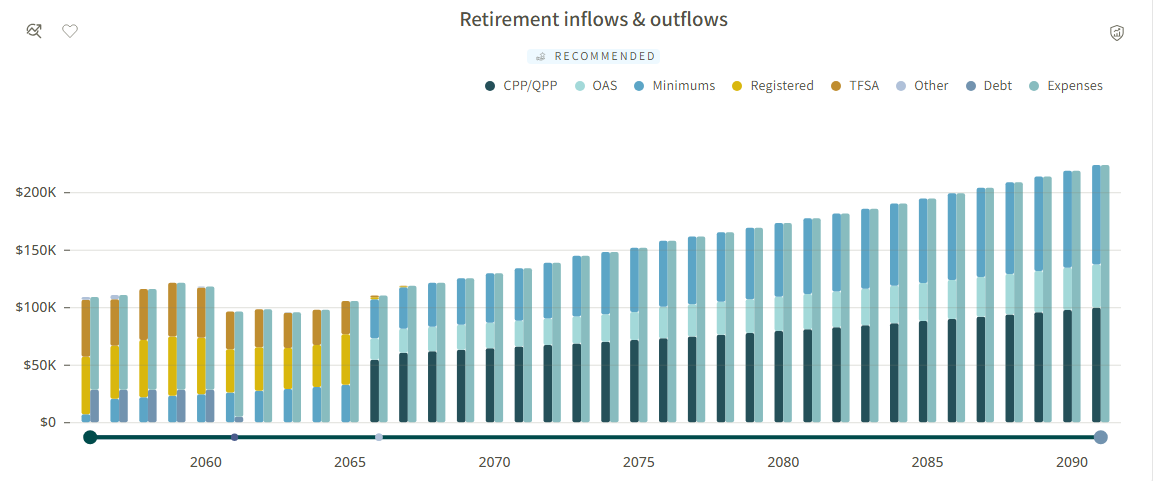
Below is a look at her projected retirement income and expenses. As you can see, she is able to maintain her desired lifestyle with approximately $3,500 per month in retirement spending while still ensuring her plan remains sustainable.
Earlier, I mentioned that each plan had to meet two important retirement criteria: first, that the client would not run out of income throughout retirement, and second, that the plan could withstand a 30% market decline one year after retirement followed by a four-year recovery period. The results of this stress test are shown below.
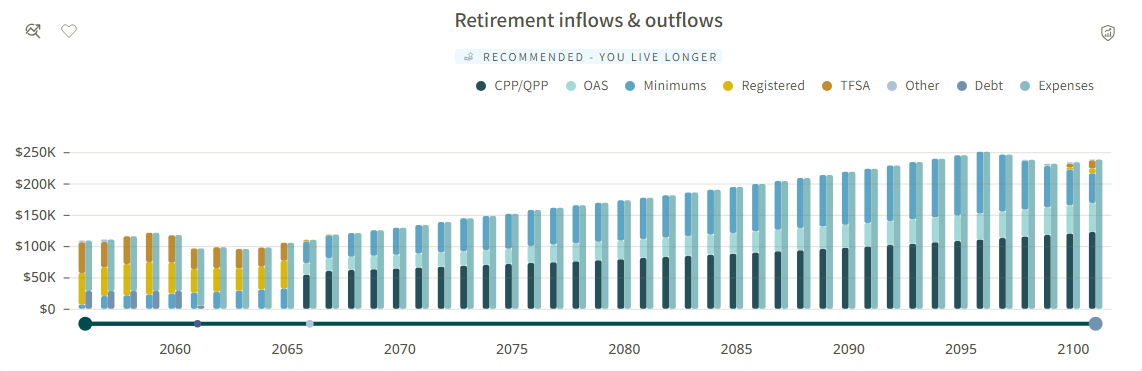
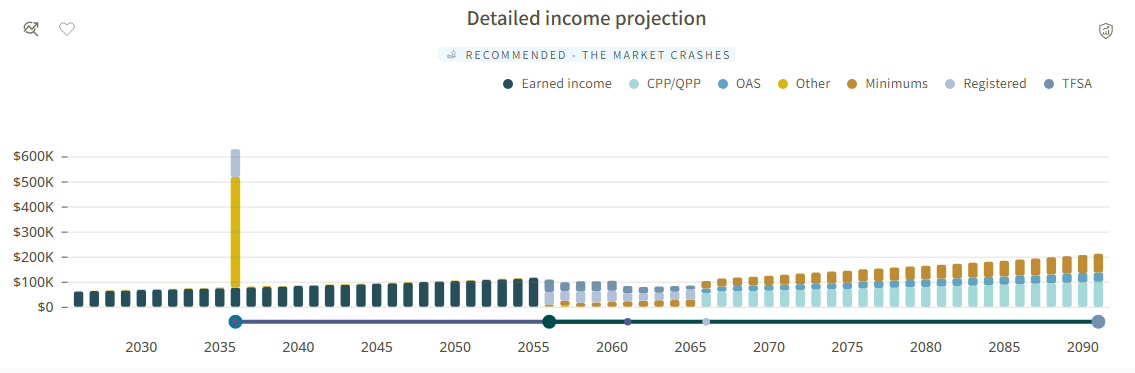
Pretty awesome, right? All Lisa had to do was create a plan and save 20% of her income and she was able to retire earlier than 80% of Canadians. Consistency, discipline, and intentionality. That's all it takes.
Let's see how Bart held up over the years.
Bart
Bart follows the same approach as Lisa when adjusting his contributions after purchasing his home. Like Lisa, he decides to place a greater emphasis on his RRSP as his income increases and uses the available tax deferral to his advantage.
His monthly contributions become:
-
RRSP: $950/month
-
TFSA: $650/month
When Bart reaches age 55, his accounts have grown to approximately:
-
RRSP: $368,919
-
TFSA: $243,931
Bart's savings rate from ages 35-55: 24.74%
At first glance, Bart's numbers don't look too different from Lisa's. His savings rate is only about 4.31% higher than hers, which may not seem like a major difference.
However, when we look at whether Bart can actually retire comfortably at 55, we start to see the impact of those five years. While retirement is technically possible, his plan does not meet the same requirements we established at the beginning of the article.
As shown in the graphs below, Bart would eventually run out of money if he maintained his desired lifestyle throughout retirement. Based on the projections, his portfolio would be depleted around age 91 (illustrated by the red bars).
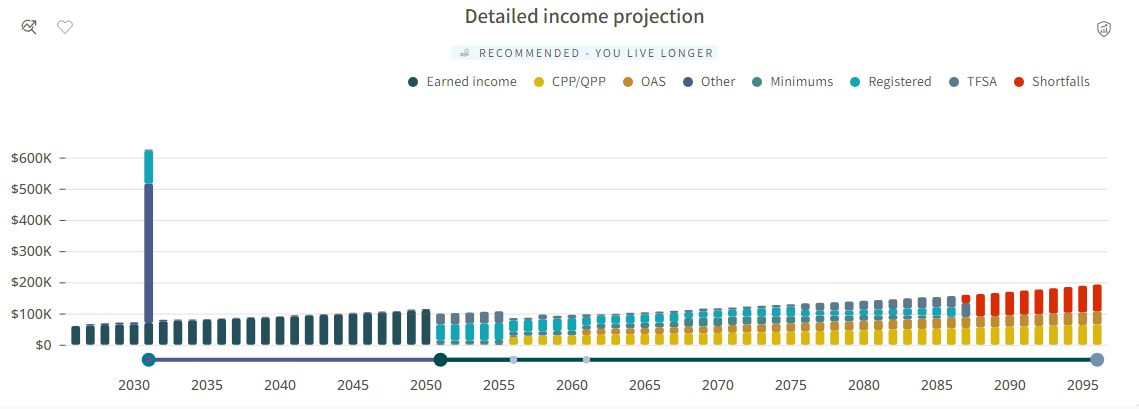
The bigger concern comes when we apply the market stress test. If Bart retired and experienced a market decline similar to 2008 shortly afterward, his plan would no longer be able to support his desired lifestyle beyond age 72. That is not what I would consider a comfortable retirement. So, Bart decides to continue working for a few more years.
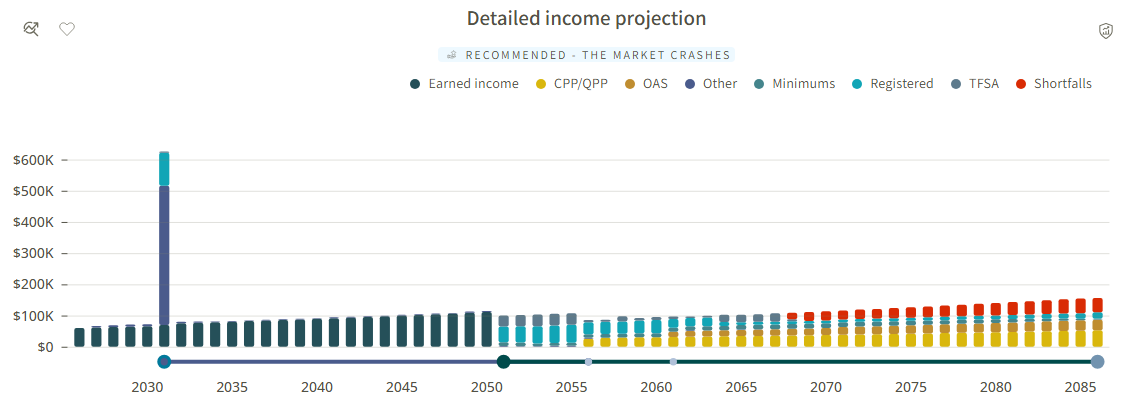
When Bart reaches age 57, he revisits his plan and finds that he can now retire comfortably. He is able to maintain the same lifestyle throughout retirement while also having enough flexibility to withstand a significant market downturn. The chart below illustrates this improvement.
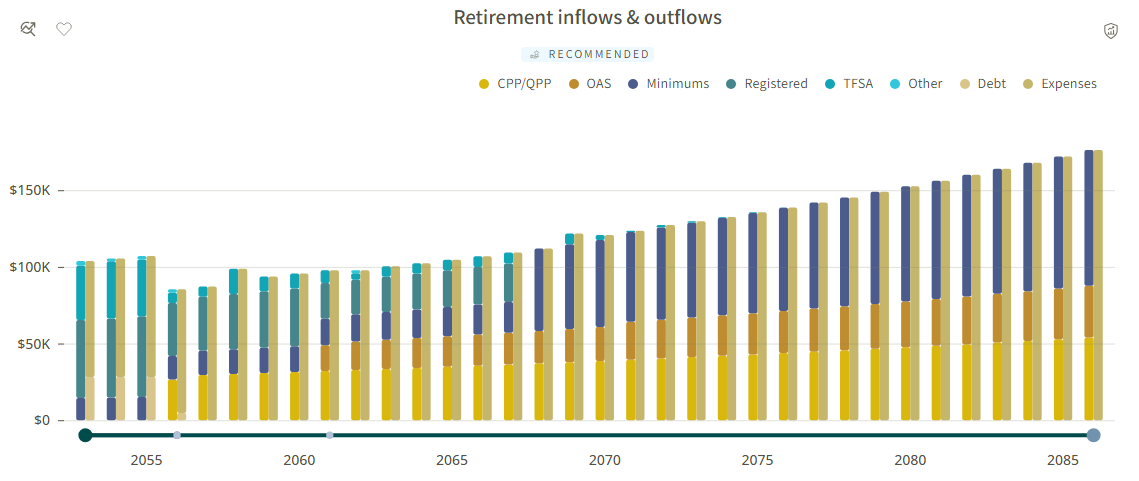
The table below shows Bart's cash flows from 2032-2035. I want you to look specifically at the line labelled "Personal and Household Expenses." This isn't a true expense, but a reconciliation account used by the financial planning software to ensure total inflows and outflows balance. What this shows is how tight Bart's budget was during those years.
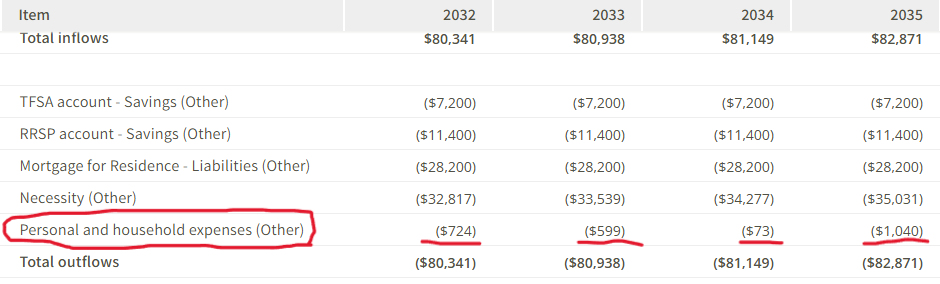
After making his investment contributions, paying his mortgage, and covering his planned $2,400 per month in expenses, Bart had essentially no room left in his budget. Now imagine something unexpected happened during that period: a major car repair, a medical expense, or even a temporary job loss. Bart would have very limited flexibility and likely would've needed to withdraw from his TFSA to cover the expense.
That is exactly what we want to avoid when building a financial plan. In a real client situation, I would likely make adjustments to create more breathing room. However, to keep this comparison fair, I left the assumptions unchanged and allowed the numbers to speak for themselves.
Wrapping things up, I hope this experiment helped demonstrate the tremendous benefit of getting started early and making intentional financial decisions that move you closer to your goals.
It's also important to remember that this was a simplified example. In the real world, there are hundreds of variables that impact a financial plan. Many of you will have families, change careers, buy new vehicles, travel, face unexpected expenses, move multiple times, and hopefully earn returns that are greater from the 6% assumption used in this example. Point is, if you were to add these variables into the equation, the impact of starting sooner and the importance of having a plan becomes even greater.
That being said, this experiment proves one important point: consistently saving 15-20% of your income starting in your 20s can put you in a position to retire years earlier, at which point you will have built up substantial wealth. The goal shouldn't be just to retire, but to create financial flexibility, have more choices throughout your life, and potentially leave a lasting legacy for the people who matter most to you.
As a reminder, if you found the financial projections and charts throughout this article helpful, these are the same types of in-depth plans I create for my clients. The plans are fluid and adapt to your life and create clear actionable steps to move you closer to achieving the financial goals you're striving for.
If you're interested in your own personalized plan, feel free to book a consultation with me. I'd love to chat.
I'll leave you with a quote I'm sure you've heard before, courtesy of Benjamin Franklin.
"Failing to plan is planning to fail."