
One thing I've noticed since becoming a Financial Advisor is that young professionals are often far more financially aware than they're given credit for.
My independent work is exclusively with young professionals, but I also spend a lot of time helping build financial plans for clients who are approaching retirement as part of my role as an Associate Advisor with our Managing Partner. Through those conversations, one thing has become clear to me: many people in their 20s and 30s already understand the basics of investing.
Most know what a TFSA is. Many have opened one. They follow financial content online, keep up with market news, and genuinely care about building wealth. It's clear that young adults today are much more willing to take the initiative to learn about investing and the importance of getting in the markets at a younger age. They know that building significant wealth today solely on income without investing would be nearly impossible. So if you're already taking these steps to become more familiar with your finances, you're ahead of a lot of people who are much older than you.
But with the increased awareness of the importance of investing also comes all the noise, bias, and misleading information.
There is more investing content available today than ever before. Social media, podcasts, YouTube channels, financial news outlets, online forums. Everyone seems to have an opinion on where markets are headed and what you should be doing with your money.
Unfortunately, all that information often leads young investors to make the same costly mistakes.
This isn't an article about finding the next stock that's going to double overnight or how to beat the market. If someone had that formula, they probably wouldn't be sharing it online.
Instead, this article focuses on five mistakes I regularly see young investors make and, more importantly, how to avoid them.
Paying Too Much Attention
At first glance, this sounds like strange advice. Isn't paying attention to your investments a good thing?
Generally, yes. The problem isn't staying informed. The problem is allowing short-term market movements to influence long-term decisions.
If you're checking your portfolio multiple times per day, following every market headline, or constantly wondering whether now is the right time to buy or sell, you're putting yourself in a position where emotions can take over.
Jeremy Siegel, author of Stocks for the Long Run, once wrote:
"Fear has a far greater grasp on human action than the impressive weight of historical evidence."
That observation has held true for generations of investors.
Most people understand the phrase "time in the market beats timing the market." They start investing with every intention of staying disciplined. Then the market drops 10%, a scary headline appears, or a recession is predicted, and suddenly they're questioning everything.
The issue is that markets have always given investors reasons to sell. Wars, recessions, political turmoil, inflation spikes, pandemics, and financial crises have all caused investors to panic at one point or another.
Yet despite all of those events, broad stock markets have historically continued moving higher over the long run.
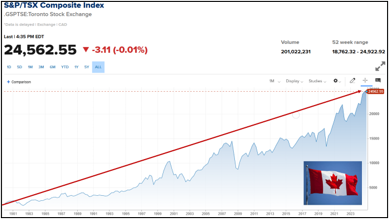
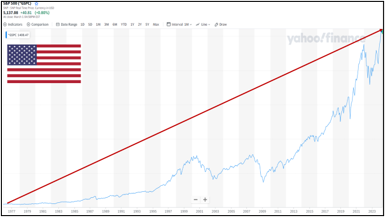
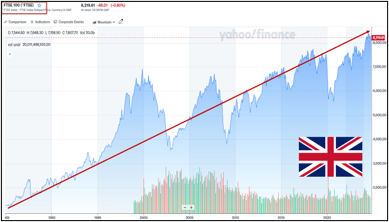
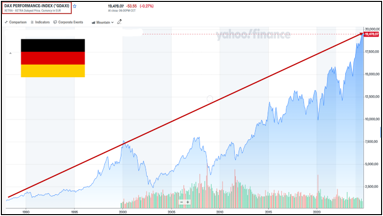
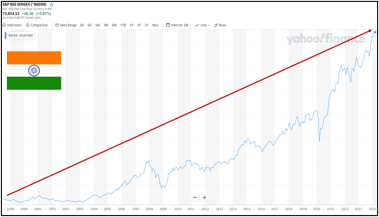
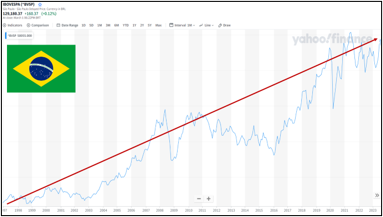
These are the indexes for 6 different countries. What do you notice about all them? They all have taken the exact same trajectory! Think of all the wars, market crashes, diseases, and political events that happened throughout this time – all which seemed like a reason “not to invest.”
But that's over a 40-year period, of course the markets will have gone up. Let's just look at a 10-year period instead from 2009-2019.
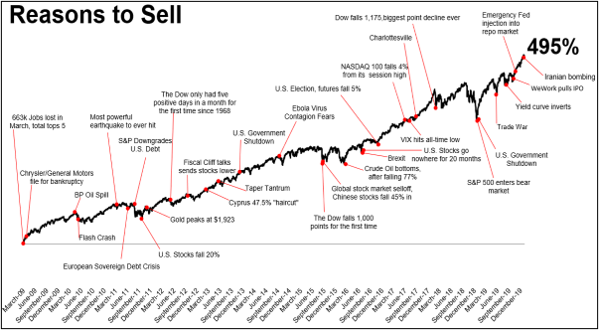
The start date of this graph (March 2009) is right when the market began recovering after the Great Recession. Think about the incredible growth people’s portfolios could’ve had if they just held. Certainly easier said than done, but crafting a portfolio that lets you sleep at night, with a fixed mindset to build for the long-term, and having someone to hold you accountable when those big recessions come - because they will come again - will make all the difference.
One of my professors at Western would always compare investing in equities to a roller coaster. "Ride the roller coaster" he'd say, through all the ups and downs, "and most importantly, never get off."
Insufficient Research
There has never been more investing information available than there is today.
Unfortunately, there has never been more noise either. Turn on the news, scroll social media, or listen to a few investing podcasts and you'll quickly realize that everyone has a different opinion. One expert says interest rates are going higher. Another says they're about to fall. One analyst believes artificial intelligence will transform the economy. Another thinks it's a bubble.
Many people rush to these experts to get a sense of certainty in a field where there is practically none. It makes sense, people want to make the right decision with their hard-earned money and put it in the right place. The problem is interest rates, market forecasts, currency valuations,... these are all things that are nearly impossible to predict accurately on a consistent basis.
Seriously, look up interest rate projections from the major banks. Rarely ever will you see any sort of consensus on if they will go up, down or remain the same. An important conclusion to come to is in finance nearly nothing is black and white. Each institution uses different models, assumptions, and data points to arrive at their conclusions, none of which are necessarily right or wrong.
That's why blindly following headlines can be dangerous. Why should you trust what one person or institution says instead of the other?
For 95% of the population, what will bring them the greatest success when it comes to investing really is a simple recipe. Understand your situation, research and select funds that align with your goals, diversify the funds, and hold.
Do you understand the different risks, opportunities and fundamentals of the investment vehicle you select?
If you choose to invest in a fund or index, what industries does it invest in? What countries is it exposed to? Does it complement the investments you already own? Does it align with your goals and risk tolerance?
For example, generally the longer your time horizon, the more aggressive you can be with your investments. So if you're looking to buy a car in the next 6 months you shouldn't have most of your portfolio in a penny stock mining company from Brazil.
Doing your own research doesn't mean becoming an investment expert overnight. It simply means understanding enough to make informed decisions that are rational to you and make sense for your situation. Investing isn't like an illness where there's a universal and correct way for it to be treated, your investment strategy entirely depends on your purpose for investing and who you are as an investor. A strategy could be perfect for one person but then absolutely terrible for the next.
Furthermore, the more you understand your investments, the more confident you'll be during periods of market volatility. The more confident you are during volatility the more likely you'll be to "ride the rollercoaster" of the markets and let compounding and time work its magic. And those two things - compounding and time - are the real keys to portfolio growth.
Non-Diversified Portfolios
If you've spent any time learning about investing, you've probably heard the word "diversification."
The problem is that many investors don't fully understand what it means. True diversification goes far beyond owning a handful of different stocks.
Think about how many industries exist around the world: technology, healthcare, financial services, energy, real estate, communications, consumer goods, industrials, and more.
Now consider the countless countries and economies driving global growth.
And how about the different sizes of companies? We all know of the incredible innovation of companies like Apple and Microsoft - these are well displayed. But what about the startup that's currently being ran by one person out of their garage that will turn into one of the biggest companies in the world like Bezos did for Amazon.
These are the three categories that create for true diversification: industry, location, and size.
But just as important as it is to get a piece of the pie that comes with all the innovation happening across the world to get greater returns, the significance and importance of diversification doesn't stem from that. It comes from limiting your downside risk.
One of the incredible things about the markets is an awful day for one company is a fantastic day for another. With each new piece of technology that emerges, a new policy introduced by governments or a breakthrough medical development - there will always be winners and losers. There is a constant cause and effect going on within markets and they often aren't as obvious as you may think.
The point is, trying to predict every winner and loser is nearly impossible.
Let's look at the Great Recession for example. If you're from Windsor like myself, we live in an auto town so ask some of your relatives that worked for Chrysler, Ford or GM how they were affected by it. Or take a look at the S&P 500 which dropped over 50% during this time. From past recounts of this time you'd probably think it was all bad and not a good time for anyone.
But with people struggling financially, where did people turn to? Cheap options to buy essentials like groceries and basic household items. What company do you know that offers this?
How about Dollar Tree? During the period of the recession (December 2007-March 2009), the share price grew over 200%.
Or more recently when artificial intelligence exploded in popularity, many technology companies benefited enormously. But then there were companies like Chegg, which I’m sure many of you have heard of. At it’s peak in 2021, the stock price sat at $113. Today it’s worth $1.30.
This is one of the first articles I've written for this website so you'll hear me mention him more in the future (because he was so incredible) but my personal finance professor at Western would always use the saying "buy all the boats."
Instead of trying to figure out which company will create the next breakthrough technology, which companies will dominate the next decade, or how different industries will react if there really is an AI bubble, simply just own all of them (the good ones that is).
In practically any other field, you can study the past to get a better idea of the future. Medical developments are built upon hundreds of years of prior research and geologic patterns of the past give us an idea of what we can expect in the future. However when it comes to investing the success of one company today versus tomorrow is based solely on how the irrational minds of investors will react to events in the future that none of us could've predicted.
When you concentrate your investments in a single company, sector, or theme, you're betting on being right.
When you diversify broadly, you're betting on the long-term growth of the global economy.
Historically, that's been a pretty good bet.
Relying on Social Media
A recent study found that 61% of young adults trust social media for investment advice.
Are you surprised? Because I'm definitely not.
Social media has become the gateway into investing for many young people. It's accessible, entertaining, and filled with creators who appear knowledgeable and confident - and some of them are.
There are plenty of creators producing quality educational content about budgeting, investing fundamentals, retirement planning, and personal finance.
But if you're around my age you know how social media works. People are trying to go viral and how do they do that? By getting your attention. Do you think someone is going to go viral by saying something boring like "stay invested, diversify, and choose index funds"?
Absolutely not. The finfluencers that get the most attention are the day traders that show they made $15k in one day. It's advice that works for about 2% of investors that get the attention of about 90% of total investors active on social media. See the problem there?
And trust me, I get it. I too, have learned that lesson the hard way. Let me tell you about it.
Back when I was in high school, I came across a TikTok creator talking about a cryptocurrency that was supposedly going to skyrocket in value. For the life of me I cannot remember what the coin was called - moon something, maybe Mooncoin. Anyways, by the time I discovered it, the coin had already increased substantially.
Curious, I jumped over to YouTube to learn more. Sure enough, there were countless videos discussing the same opportunity. After about 30 minutes of research - which in hindsight wasn't really research at all - I was convinced I had found a hidden gem.
I invested roughly $500, which at the time was a significant portion of my savings.
For a short while things looked promising. I was up about 10% but went downhill pretty fast from there.
Down to $400, then a couple weeks later $300, then $150. At that point I figured I’d recoup my losses and sold what I had left.
A month later it was worth literally nothing.
There is so much I did wrong here. I didn’t know nearly enough about crypto to start trading, knew next to nothing about the coin, then I bought it at it’s peak and sold it at less than half of what I purchased it for. Most importantly, I allowed social media buzz to replace actual due diligence
The lesson isn't that every investment discussed online is bad. The lesson is that nobody on social media knows your goals, risk tolerance, time horizon, or financial situation and every opinion you see on social media must be backed by your own research. Really, if it were me, the extent of which I'd take social media as an educational platform is learning about how investing works: different ways to invest, accounts you can hold, characteristics of different investment vehicles - things of that nature. I would never use it however as your primary decision maker in what funds, companies, cryptocurrency, etc. you choose to invest in.
Before investing your hard-earned money, make sure you understand exactly what you're buying and why you're buying it.
Not Utilizing Government Accounts
If there's one mistake on this list that can have an immediate impact on your long-term wealth, it's failing to take advantage of the accounts available to Canadian investors.
Over the past two decades, the Canadian government has introduced several accounts designed to encourage saving and investing. Yet many young professionals either aren't using them or aren't using them strategically.
The Tax-Free Savings Account (TFSA) is a great tool for those early in their career. For the 2020 contribution room, only 44% of Canadians between ages 18-34 held one. Among that 44%, only 65% actually contributed to it.
Any investment growth earned inside a TFSA is completely tax-free. Better yet, withdrawals are also tax-free, making the account incredibly flexible for both short-term and long-term goals.
Looking to start saving for a home? The First Home Savings Account (FHSA) offers some of the best tax advantages available to young Canadians. Contributions are tax-deductible like an RRSP, while qualified withdrawals are tax-free like a TFSA.
As your income grows throughout your career, Registered Retirement Savings Plans (RRSPs) often become increasingly valuable as well. Contributions can reduce your taxable income, potentially saving thousands of dollars in taxes over time.
The key isn't simply opening these accounts, it's using them consistently.
Too many people believe investing only makes sense when they have large sums of money available. That's simply not true.
Building wealth is usually the result of hundreds of small decisions repeated over many years.
Whether you can contribute $50 per month or $500 per month, taking advantage of these accounts today can make a tremendous difference decades from now. This process - investing small amounts regularly at a selected time interval - is called dollar cost averaging (DCA).
You might hear someone say "oh, well, mathematically your returns are better if you only invest large lump-sums at a time rather than small amounts consistently." 🤓
To me that's a load of bull crap. No one is a fully rational investor, we are all irrational by nature. Investing is about doing what works for you. While it may "technically" be true, if you only have small amounts you can contribute right now, you are far better off than waiting and hoping for the day where you can contribute a large sum of money at once. I've said it once and I'll say it again, if you're young you have time and therefore compounding on your side and those are the two most important factors to building wealth.
In conclusion, too often people are introduced to investing by thinking they need to find the next big stock or performing loads of technical analysis to put them ahead of everyone else. When it comes to finance where there is winners there simply must always be losers - the basic laws of arithmetic say so and this is indisputable. In any given year the winners won't always stay as winners just like how losers won't always be losers.
Unless if you're trying to be a day trader or a portfolio manager your optimal path to building wealth through investing is a diversified portfolio and most of all, an outstanding display of patience and discipline.
So take the advice of my professor - buy all the boats, ride the rollercoaster, and never get off!