I recently met with a client and it served as a reminder of just how expensive life is.
A bit of context: she's 37, married, and has two young children - one four years old and the other two years old. Both her and her husband make incomes of over $100,000 per year, but yet worry they will have to retire much later than they'd hope to take care of their kids and be able to fund a retirement they want.
And the thing is they're not overspending. Their monthly expenses consisted only of groceries, car expenses, utilities, and daycare. The total of those four things? $3,100 per month.
That doesn't even include their debt. Between their mortgage, car loan, and line of credit it's $2,500 per month.
That's $5,600 per month with not a lot of room to cut back on, and this brought us to an interesting point in the meeting. She said they were holding off on contributing regularly to their investments because they want to focus solely on their debt.
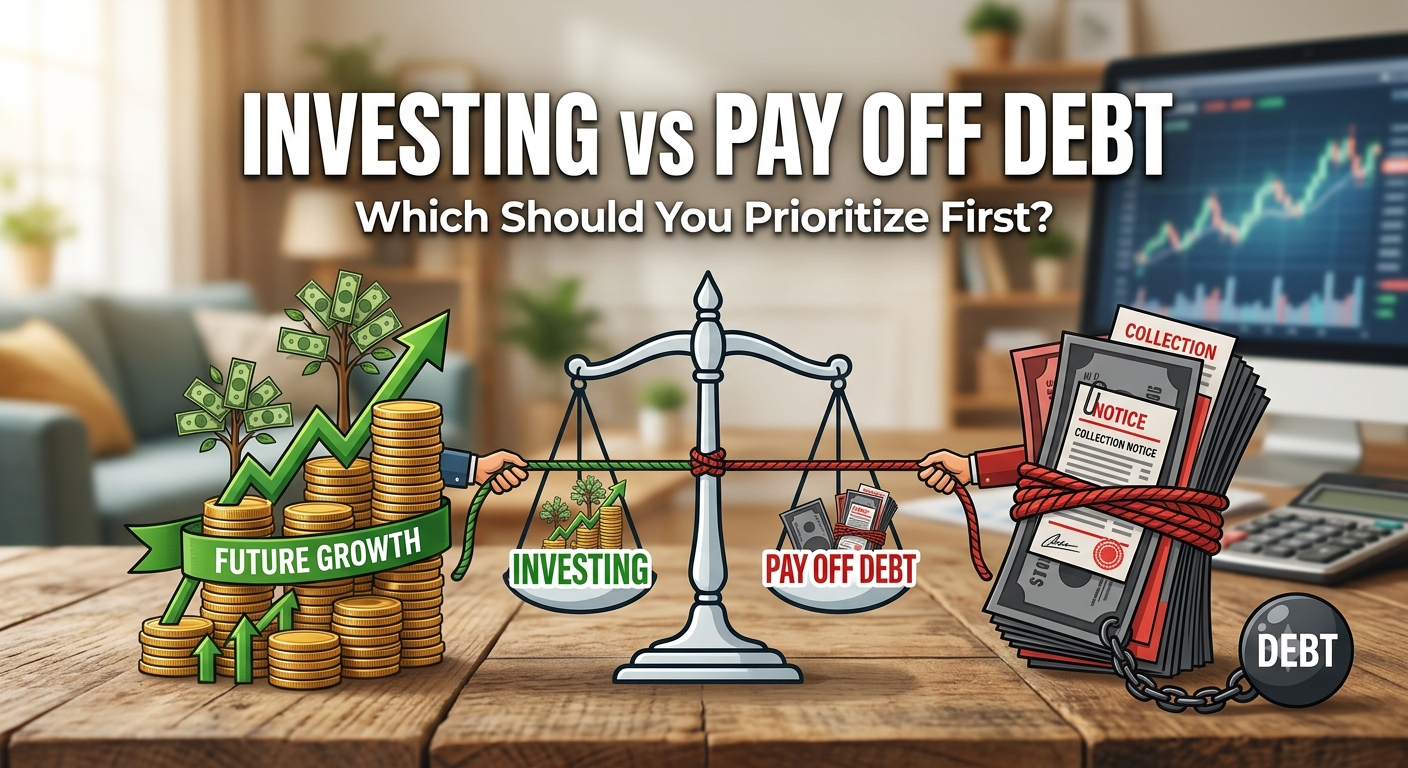
But is this the right decision?
I want to clarify now that there isn't a definitive answer to this and differs on a person-by-person basis. However, I do want to use this article as an opportunity to provide examples of where perhaps you might want to lean more one way than the other.
As with most financial strategies, there is no one-size-fits-all solution and what you decide to do should be done in the context of your situation and no one else's. If you're looking for a personalized strategy for how you should approach your debt, book a meeting with me and I'd be glad to discuss it with you.
With that being said, let's dive into some different types of debt and some different approaches you can take with each.
Paying Debt First
I'm going to come out and say it straight away. In most cases, especially for those in their 20s and 30s, I would recommend clearing all debt first. Of course there are exceptions to this otherwise I wouldn't be writing this article, but let me explain why I generally take this stance.
Something I always found quite interesting is how for most, one of the first money lessons you're taught is that debt is bad and not to accumulate too much of it. We know we should save and most of us know we'd be better off avoiding impulsive large purchases and redirecting it toward our future instead.
But yet, so many end up becoming so comfortable with debt. They simply just learn how to live with it. Instant gratification is a widespread thing now and for most if they see something they want, they rationalize the purchase in their head and convince themselves it's okay and do it.
This is poor person behaviour and an easy way to ensure you will never build significant wealth.
This is a big problem because even if they try to invest while slowly paying off these debts, a big squeeze is placed on their lifestyle and budget. So guess what will happen when the next tempting "want" or even an actual need comes around? They will almost always choose to delay investing. Big mistake.
That's why in almost all situations at this age I suggest hammering on your debt first. You're still young and can avoid the habits that get so many Canadians stuck living check to check. And once you get that debt paid off, you don't need to go back in debt again - unless if it's for the purpose of building your wealth.
I'm going to discuss a few common types of debt where in most situations, I'd recommend paying off debt before investing.
Credit Cards
This one is a no-brainer. If you have significant credit card debt it's crucial you prioritize clearing this over investing. In almost all circumstances if you have multiple sources of debt, paying off your credit cards should be at the top of your list to pay off. Most credit cards charge interest of at least 18% and unless you're Warren Buffett, you're certainly not going to earn that consistently off your investments.
On top of that, late payments or making minimum payments on your card are a quick way to tank your credit score. So later on in life when you do want to take on debt to build your wealth, like a mortgage or getting an education, good luck.
Car Loan
If you know me you know my stance on financing or leasing vehicles - avoid it at all costs. Cars simply burn a hole in your wallet and you will be far better off purchasing one outright rather than leasing or financing. The only situation where leasing a vehicle might make sense is if you're self-employed as it may be tax-deductible.
If you do end up financing a vehicle and your interest rate is anything above 5%, you should opt for the shortest financing period and get it paid off ASAP. Aside from avoiding too much interest, the problem with cars is on top of your monthly car payment, just how many other expenses are associated with them. Insurance, gas, repairs... too many people end up putting far too much of their take-home pay towards their car when they'd be far better off allocating it elsewhere.
Which Debt Should be Paid Off First?
When you're looking to become debt-free, there are two primary methods for how to tackle them: the snowball method and the avalanche method.
We'll start by talking about the snowball method. This process involves listing out your all your debts and making minimum payments on all them, except for your smallest debt, which you will pay extra on. Once the smallest debt is paid off, you make extra payments on the second smallest debt, and so on until it's all paid off. Let's take a look at an example.
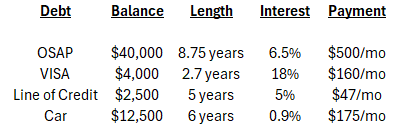
We'll call this guy Doug. Below is a list of his outstanding debts.
Now, let's rearrange them in order of his smallest to largest debt.
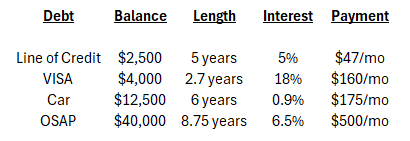
So, Doug will continue making minimum payments on his VISA, car, and OSAP, while making extra payments to his line of credit. Once the line of credit is paid off, he'll add $47 per month to the amount paid on his VISA. This will get the VISA paid off around 30% faster.
Then, once the VISA is paid off, he'll redirect $207 per month to his car payments ($160 + $47). This will get his car paid off approximately 50% faster! He'll continue doing this until the entirety of his OSAP debt is cleared.
The great thing about this method is the psychological advantage it provides. While yes, you will pay a bit more in total interest since mathematically it's not the most efficient, as you see your debt get cleared faster and faster you'll become even more motivated to pay them off.
Now, let's take a look at the avalanche method. This is the most logical approach mathematically - you list out all your debts, make the minimum payment on all them, except for the one with the highest interest rate, which you will pay extra on. Once that's cleared, you'll move to the debt with the second highest interest rate and so on.
Using Doug's example again, this is the order he'll pay the debts off with the avalanche method.
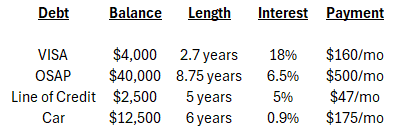
Many will instantly assume this is the better method since you're paying less interest over the long-run. However I think the answer as to which method is more effective comes down to your spending habits.
The thing is about racking up debt is if someone did it once, there's a good chance they'll do it again, especially when it comes to things like a credit card. Impulsive large purchases, expensive trips, lots of trips to the mall... unless if while they are paying off this debt they are determined to make a lifestyle change, this method can be a bit ineffective.
Why? Because once they finally pay off their $4,000 in credit card debt, they'll probably justify using it again for their effort and then we're right back to square one with paying off the credit card. However, if you are determined to pay off your debts and looking to pay the least amount of interest possible, mathematically this is the right choice.
Investing While Paying Off Debt
From a numbers standpoint, the two biggest factors that determine whether you should prioritize paying off debt or invest while paying it down are the interest rate and the size of the debt. If you have a large balance with a relatively low interest rate, it often makes sense to invest at the same time rather than putting every extra dollar toward repayment. The longer your money stays invested, the more time it has to compound.
One form of debt many people in their 20s and 30s are dealing with is student loans. If you have a sizeable student loan balance, it will often make sense to gradually pay it down while continuing to invest. Student loan rates fluctuate because they're tied to the government's prime rate, but as a younger investor you likely have a longer investment horizon. That typically means you can take on a more growth-oriented portfolio with higher expected long-term returns. If your student loan interest rate is in the 5-6% range, history suggests a diversified equity portfolio has the potential to outperform that over the long run. While there are never guarantees when investing, giving your money more years to compound can often outweigh the benefit of aggressively paying down a relatively low-interest loan.
The same concept generally applies to mortgages and lines of credit. These are often among the lowest-interest forms of debt you'll carry, but they're also usually the largest. Because of that, it often makes sense to continue investing while making your required payments rather than waiting until the debt is completely gone before entering the market. (side note, "typically" doesn't mean it should be. I'm referring to the line of credit here. Don't use it like it's a credit card!!)
Speaking of mortgages, a question I hear all the time is, "I have extra money each month. Should I invest it or put it toward my mortgage?"
The answer comes down to comparing the expected long-term return on your investments with your mortgage interest rate, while also considering your personal preferences. Some people value maximizing their long-term wealth and are comfortable carrying a mortgage for longer if it means staying invested. Others simply sleep better knowing they're debt-free as quickly as possible. Neither approach is inherently right or wrong. The best decision depends on your goals, your comfort with debt, and your overall financial plan.
One final perspective I want to offer that hasn't really been mentioned to this point is the mental side of debt. The thing is about people is we're not robots and can often be irrational. A solution that makes the most sense on paper may not be the solution we choose because of biases, feelings, and beliefs among other things. As a financial planner, our ultimate goal is to create a solution that both helps you achieve your goals but just as importantly, makes sure you're still able to sleep at night.
We've looked purely at the quantitative side of this debate, however it would be wrong to not talk about the qualitative side as well. Some people are very opposed to holding debt and feel like it places a large burden on them. In this case, despite what the numbers say, you might be better off focusing on getting rid of your debt first.
Ultimately, the goal here is to provide you with important factors to consider and questions to ask yourself when deciding how to navigate paying off debt. There are a lot of different things to consider - your current financial situation, type of debt, debt features, investment risk tolerance, and your personal stance on debt, all of which should factor in to how you choose to approach getting rid of your debt while still setting you up for the future.
If you wish to get a personalized perspective on which route is best for you by taking into consideration all the moving variables in your life, I encourage you to reach out for a chat.