
Last month, ChatGPT released a new personal finance feature that allows users to connect their personal banking to the platform for a personalized experience when it comes to questions about budgeting, investments, and planning for their future goals.
From their website:
With your financial accounts connected, ChatGPT can combine that reasoning with your real financial context and what you’ve shared about your goals, lifestyle, and priorities, helping you spot patterns, understand tradeoffs, and plan for big decisions in a way that feels more personal and complete.
This, of course, is a huge advancement for AI when it comes to finance-related questions considering ChatGPT already gets millions of inquiries about these topics each month. It will be accessible to everyone with the "Pro" membership, which is about $10 per month.
You may think that as I'm a Financial Advisor, I'll be looking for any way possible to diminish its capabilities and encourage you not to use AI for your finances. For me, that's not the case at all.
First, I would be naive to say I didn't see this coming. With the leaps AI has made the past year alone, a feature like this seemed inevitable. Secondly, I actually enjoy when my clients come to me with financial advice from AI. It means they're curious and genuinely motivated to improve their finances and whether the advice it offers is good or bad, it's a great opportunity to learn.
And generally, I think AI can be good for answers to simpler questions - especially when it comes to things like budgeting. But it does have its downfalls, especially when it comes to more complex plans with tax-efficiency and insurance recommendations. (For example, it suggested a strategy to one of my colleagues' clients that would've cost them $90,000 in taxes). In relation to this new personal finance feature, I'm also not sure how comfortable I'd feel with ChatGPT having access to my bank accounts, but to each their own I guess.
I was curious though, I wanted to see how AI would do with building me a comprehensive financial plan. I'm sure many of you reading this have asked AI finance-related questions so I believe it would be valuable for you to know where you can rely on it to give you solid advice and in what areas you should maybe look elsewhere.
How It Will Work
Unfortunately, the personal finance feature is limited to US users for now, so as much as I'd love to give it a try, I as well as all of you will be stuck using the regular model. I will however be testing it on both ChatGPT's "Plus" subscription. To be honest, I'm not sure if the response quality is significantly different between the free and paid models but I figured since I'm putting this much work into this article might as well go all out.
I have created a list showing monthly inflows and outflows. I've also written an in-depth prompt to give the AI more context about who I am, what kind of investor I am, and my goals for the future. I want to be fully transparent about what I'm giving the AI so I've included all necessary details below. If you're just interested in the findings, you can skip past this part.
Personal Information
-
I am a 23-year old male living in Windsor, Ontario
-
I have a partner who is still in school but expects to make $65k per year in 2027 when she graduates
-
I currently live in an apartment
Investments, Insurance, Outstanding Debt, and Group Benefits
-
My partner will have a student loan of approximately $20,000 to pay off. I have no outstanding debt
-
I am an aggressive investor with a long-time horizon (over 10 years). I want to be invested fully in equities but ensure the portfolio is diversified across size, geographic location, and sector
-
I have multiple investment accounts with the following market values: TFSA - $25,000; FHSA - $8,000; Group RRSP - $3,500; Emergency Fund - $900; Bank Account - $2,000
-
My employer provides life insurance with a benefit of $50,000, disability insurance at 66.7% of weekly earnings to a max of $700 per week, and a CI benefit of $25,000
-
Since I make $80,000 gross per year, 4% is contributed to my group RRSP along with my employers match, meaning I contribute $6,400 to it each year
-
I expect my salary to increase by at least 4% each year
-
I don't have any insurance at the moment but am looking to purchase a policy soon
-
Prioritize tax-efficiency over liquidity
Goals and Upcoming Major Expenses
-
I want to purchase a home by the time I turn 28 years old. My estimated home price is $450,000
-
I am looking to purchase a car in the next 2 years, however I won't spend more than $15,000
-
I love to travel the world and spend approximately $5,000 each year on travel
-
Targeting retirement by age 55
Now, I'm going to have ChatGPT to build me a full monthly budget, investment recommendations based on my investor profile, insurance needs, and a full financial plan to ensure I meet all my upcoming major expenses on time. We'll go through each major section of the financial plan in-depth then provide final conclusions at the end of where AI did well and where it struggled.
By the way, for the sake of keeping the article from getting too long, we will just be going through the main components of the plan. If you're curious to see the full financial plan, send me a message and I'd be happy to send it over to you.
Cash Flow and Budgeting
Going into this, I predicted cash flow and budgeting would be one of AI’s biggest strengths, and sure enough, it did quite well in this area.
When creating the prompt for the plan, I included all of the client’s monthly inflows and outflows in one large paragraph. ChatGPT did a great job of identifying each one, organizing them into categories, and creating a clear visual showing exactly where the client’s money was going each month.
One small criticism I would make is that I wish it had shown how it calculated the client’s net monthly income from their gross income. I think it’s valuable to see exactly how much of your paycheque is going toward CPP contributions, EI premiums, and income tax. Not only does this provide a clearer picture of your cash flow, but it can also make tax planning and reporting easier later on.
That being said, this likely could have been addressed with a simple follow-up prompt asking ChatGPT to provide a breakdown of those deductions.
Below, you’ll see the budget it created and its analysis:
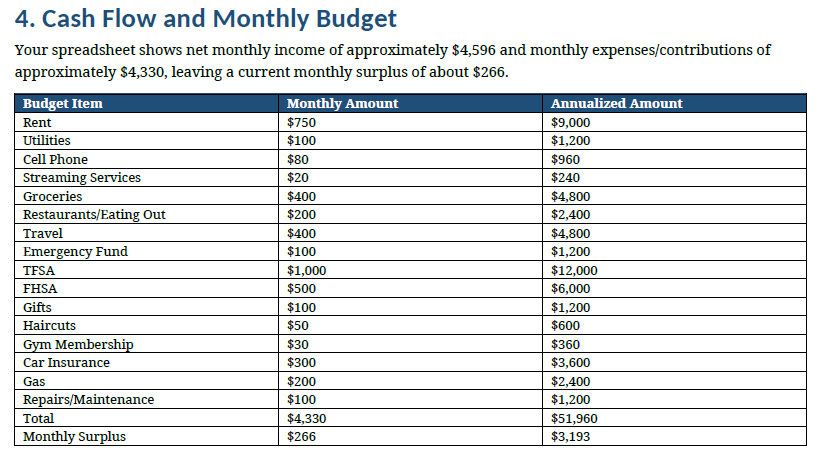
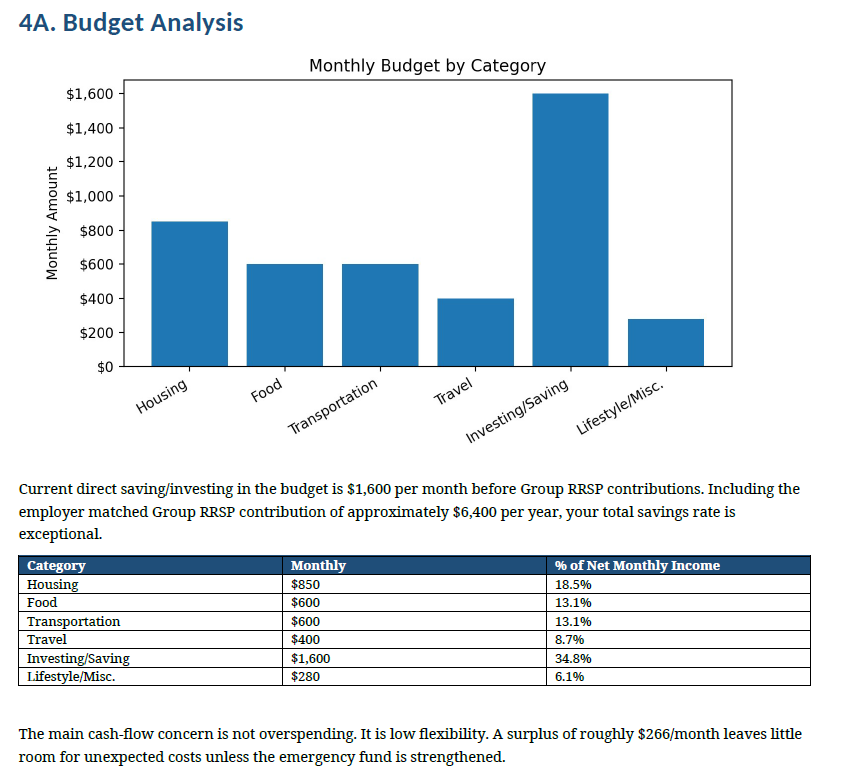
I like the analysis ChatGPT provided here. Our sample client is a very strong saver and doesn’t overspend in categories that often eat up a large portion of someone’s monthly income, such as housing and transportation, so I agree with its conclusion that cash flow isn’t a major concern.
I also like that it pointed out the client’s limited flexibility due to having such a tight budget and a relatively small emergency fund. While the client is saving a significant amount each month, there isn’t much room in the budget for unexpected expenses without reducing savings or dipping into the emergency fund.
The emergency fund will end up playing a significant role in AI’s recommendations later in the plan, but I like that it identified this potential issue early on rather than simply looking at the high savings rate and concluding that everything was fine.
Investment Account Breakdown and Recommendations
Looking at the client’s current investment breakdown below, AI does a solid job of analyzing how their monthly contributions are currently being allocated.
One recommendation I agree with is placing a greater emphasis on the FHSA. While it doesn’t specifically say the client should contribute the full $8,000 annual contribution limit, it seems to imply that maximizing the account should be a priority given their goal of purchasing a home in five years.
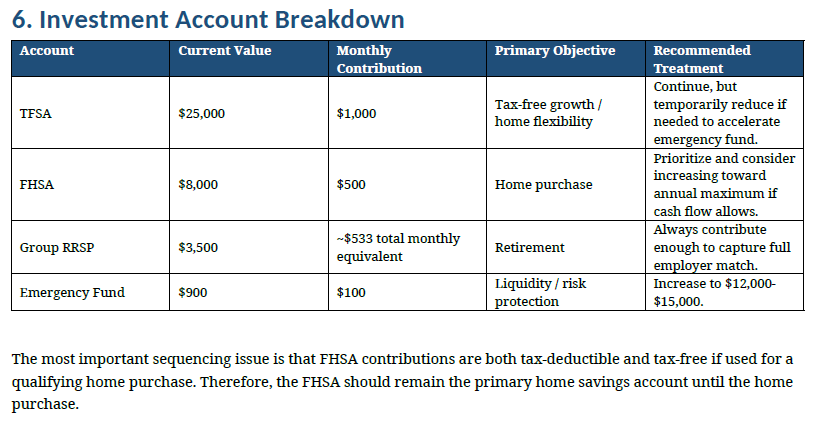
I do have a criticism here though. AI also recommends increasing the client’s emergency fund while reducing TFSA contributions to make that happen. I actually agree with the recommendation itself, but I wish it had provided specific instructions on HOW to implement it.
It recommends increasing the emergency fund from $900 to somewhere between $12,000 and $15,000, but by when? How much should the client redirect from their TFSA contributions each month? How long will it take to reach the recommended emergency fund target? And perhaps most importantly, how will reducing those contributions affect the client’s projected TFSA balance at retirement?
This is simply just too vague. Increasing an emergency fund from $900 to potentially $15,000 is a significant change that will have implications for other areas of the financial plan. If AI is going to recommend reallocating thousands of dollars away from long-term investments, I think the plan should clearly show how to do it and what the trade-offs will be.
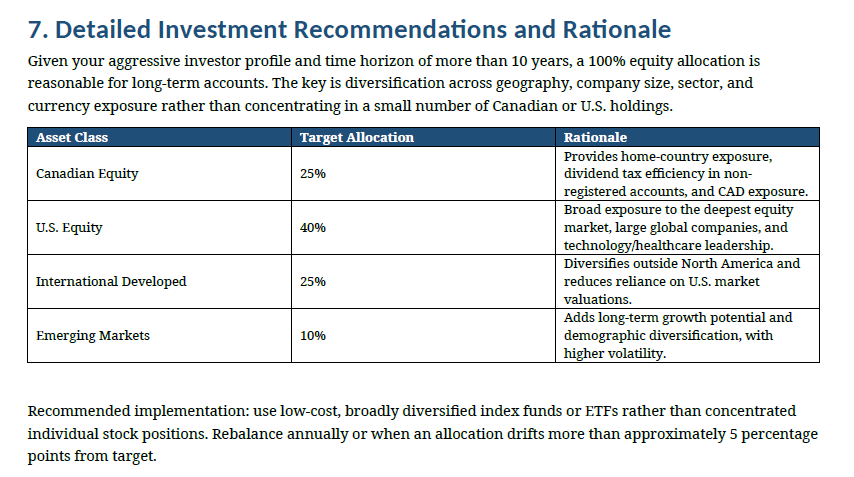
There isn’t too much to criticize with the recommended portfolio breakdown itself. I’m glad to see AI didn’t recommend individual stocks and instead suggested using index funds and ETFs diversified across different asset classes and geographic regions. For an aggressive investor focused on long-term growth like our client, it’s a reasonable portfolio. It encourages diversification, and recommends rebalancing the portfolio annually.
However, there is one issue with this recommendation that leads into the next section.
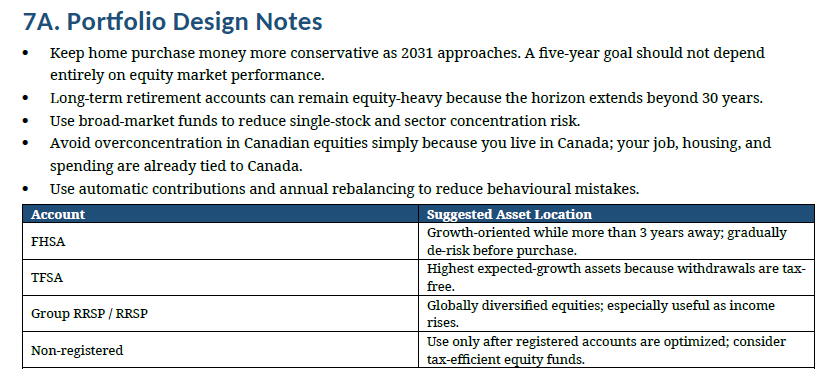
Looking at the additional notes provided by AI, several of the recommendations make sense. Using broad-market funds, automating contributions to reduce impulsive investment decisions, and avoiding concentrating investments entirely in Canadian equities simply because the client lives in Canada (obviously lol).
But there's also a contradiction here...
AI appears to recommend using the portfolio allocation from the previous section across ALL of the client’s investment accounts. At no point does it clearly suggest otherwise. Yet in the notes below, it says the client should begin shifting the FHSA toward more conservative investments three years before purchasing the home.
Personally, I wouldn’t recommend the portfolio AI created for the FHSA even five years away from the home purchase. The allocation is far too aggressive for money that will be needed for such a significant purchase in the relatively near future.
This highlights one of the biggest weaknesses I found throughout the entire financial plan: nothing is stress-tested. Throughout the plan, we’re essentially assuming everything goes according to plan.
What happens if we experience another major market downturn a year from now and the client’s FHSA portfolio falls 30%? Suddenly, their goal of purchasing a home in five years becomes significantly more difficult, if not unrealistic. A strong financial plan should account for scenarios like this. What happens if investment returns are lower than expected? What if the home purchase happens earlier than planned? What if the client loses their job and needs to rely on their emergency fund?
None of these scenarios are explored.
Again, it’s another example of the financial plan feeling very surface-level and lacking depth, which it certainly shouldn’t given that the plan is 23 pages long.
Insurance Needs & Analysis
Our sample client doesn’t require much insurance coverage at the moment. They have no debts, relatively few assets, and haven’t started a family yet. ChatGPT identified this correctly while also recognizing that the client’s insurance needs will change significantly over time with marriage, a mortgage, children, and other major life events.
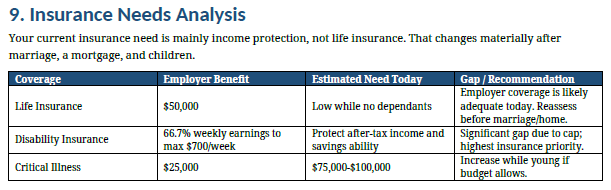
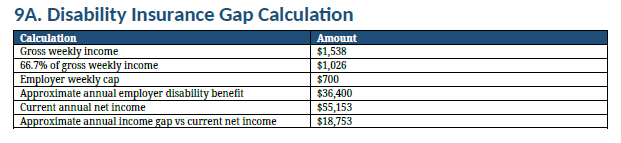
Looking at the client’s insurance needs today, I think ChatGPT does a pretty solid job. I like that it clearly lays out the calculations used to identify the gap in disability insurance coverage rather than simply recommending more coverage without explaining why.
It also recommends purchasing additional critical illness insurance while the client is young and coverage is relatively inexpensive. Beyond the life insurance provided through the client’s employer, there isn’t much of a need for an individual life insurance policy right now given the client has no debts or financial dependants.
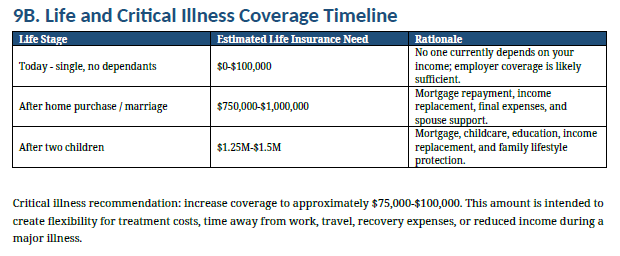
Now let's take a look at the future. We can see a significant increase in the client’s insurance needs as they move through major life stages like purchasing a home, getting married, and having children.
That being said, I do think the estimated life insurance needs are a bit inflated though since AI seems to have forgotten about the spouse’s income. If our client were to pass away, we would obviously want enough coverage to pay off outstanding debts, cover final expenses, provide for their children, and replace a portion of the income the household has lost. However, the surviving spouse would still be earning an income, and household expenses would naturally change with one less person to support.
The insurance amounts recommended by AI seem more appropriate for a scenario where the client’s spouse isn’t working and the family is completely dependent on the client’s income.
This is another example of where I think AI could have done a better job of connecting information across different sections of the financial plan. The spouse’s income was included in the original prompt, but it doesn’t appear to have been properly incorporated into the insurance needs analysis.
The calculations themselves may look detailed, but if important information about the client’s financial situation isn’t being considered, the final recommendation can still be misleading.
Home Purchase
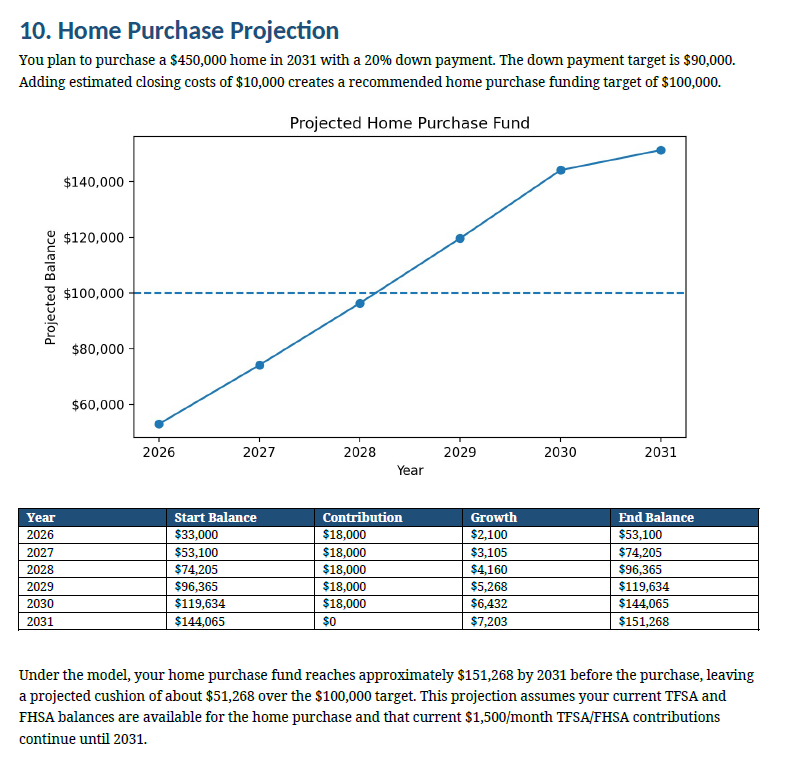
Our AI-generated plan assumes the client will use the full value of both their TFSA and FHSA to help fund the home purchase. It also keeps in mind the original assumption that the client wants to make a substantial 20% down payment on a $450,000 home. Let’s break this down.
We'll start with the good. I do like how AI projected the account values leading up to the home purchase. It follows its earlier recommendation to gradually reduce the risk within the FHSA as the client gets closer to 2031. This is reflected in the projected returns. The plan assumes a 6.36% rate of return in 2026 while the portfolio is still more aggressive, before reducing the expected return to 5% as the FHSA becomes more conservative closer to the purchase date. I also like that it accounted for closing costs. These are one of the many “hidden” expenses that come with buying a home beyond the listed purchase price, and they can easily be overlooked when someone is focused solely on saving for the down payment.
Now for the bad. First, the plan could do a much better job of using the full context of the client’s situation. At the client’s current contribution rate of $500 per month, they will only contribute $6,000 to the FHSA each year and will never reach the $8,000 annual contribution limit. I’m not saying that using part of the TFSA toward the down payment is necessarily a bad idea. However, earlier in the plan, AI specifically recommended prioritizing the FHSA. If that’s the recommendation, why wouldn’t it suggest redirecting some of the client’s monthly TFSA contributions toward the FHSA so they can maximize it each year? After all, the goal of the TFSA is to fund their retirement, not take a large chunk out of it to buy a home.
I also wish the plan had done a better job of challenging the client’s assumptions. A 20% down payment is substantial, and I’m not convinced it would be the best option for this particular client. Why not also project a scenario using a 10% down payment? Over the next five years, this could allow the client to maximize the FHSA and contribute a total of $40,000. They would then only need to withdraw approximately $5,000 from the TFSA to reach a $45,000 down payment. To me, that approach makes much more sense when balancing the client’s homeownership goal with their long-term retirement plan. It would allow them to purchase the home while preserving significantly more of the TFSA for retirement.
Of course, a smaller down payment would also introduce other considerations, like higher monthly mortgage payments. A strong financial plan should compare those trade-offs rather than simply assuming the largest possible down payment is automatically the best choice.
Finally, the projections don’t reflect AI’s earlier recommendation to reduce TFSA contributions and redirect that money toward the emergency fund. The home purchase projection assumes the client will continue making their current TFSA contributions, even though another section of the same plan recommends lowering them. Another contradiction within the plan.
If the client follows the emergency fund recommendation, the projected TFSA balance available for the home purchase would be lower. If they maintain their current TFSA contributions, then the emergency fund recommendation may not be realistic. The plan can’t assume both scenarios at the same time.
Retirement Projection
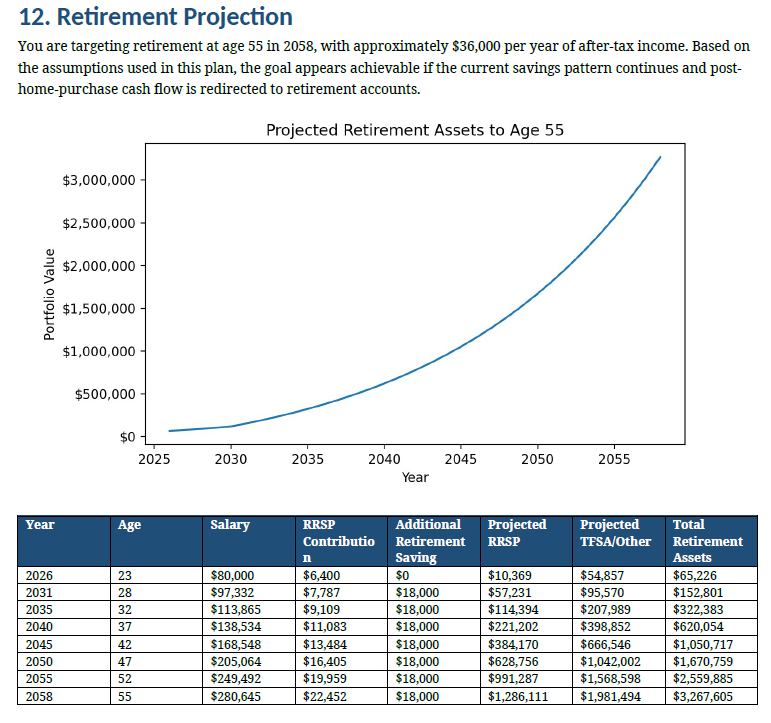
Unfortunately, this is where the plan really starts to fall apart. There is a lot we can dig into here with the numbers provided but there are two large problems here that completely invalidate the numbers given anyways.
First, ChatGPT seems to have forgotten that this client will eventually have a family. The plan doesn’t properly account for spousal income, despite that information being included in the original prompt. It also completely ignores the fact that the client is expected to have two children by 2035. Do we know how expensive kids are? There’s no adjustment to the client’s future expenses to account for childcare, food, clothing, activities, larger housing needs, or any of the other costs that come with raising two children. And apparently, the kids won’t be getting an education either because not once throughout the entire financial plan is an RESP even mentioned.
In short, the projections assume the client’s financial life will remain largely the same in 2058 as it is today. That’s a big problem.
The second issue is that the projections are incredibly generous and optimistic. In a perfect world, maybe the client’s salary grows by 4% every year, their investment portfolio earns 7% annually, and they never experience a major unexpected expense or interruption to their savings. But in reality, there is zero chance that will happen. Over the next 30 years, there will almost certainly be periods of lower investment returns, changes in employment, unexpected expenses, changes in spending, and major life events that affect how much the client can save.
For a financial plan looking this far into the future, there needs to be some form of stress-testing. What happens if the portfolio earns 5% instead of 7%? What if the client’s income grows more slowly than expected? What if they take time away from work, face a major expense, or simply can’t maintain the same savings rate once they have children? No one knows what the client's life will look like 30 years from now and that's what makes testing different scenarios important. Simply assuming the best case scenario for the next three decades is more of a wish than a financial plan.
Action Plan
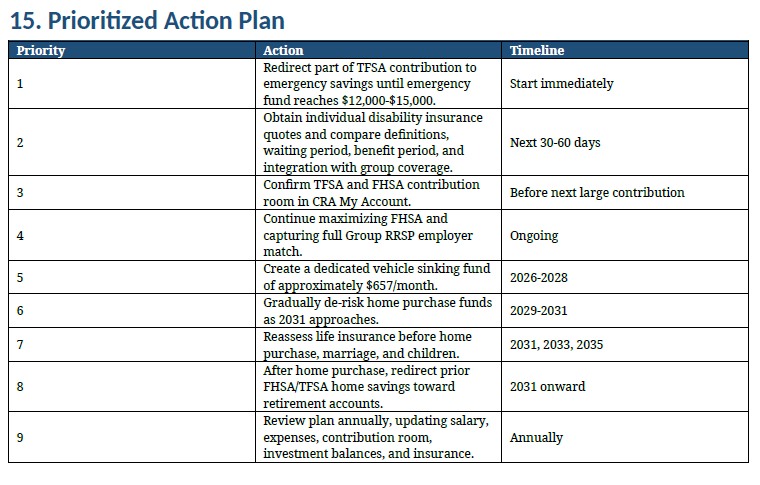
Finally, we have the action plan. Based on the recommendations made throughout the financial plan, ChatGPT does a good job of organizing everything into a clear timeline and giving the client specific action steps to follow. A 23-page financial plan contains a lot of information, summarizing the recommendations into a list of priorities will make it easier for the client to actually follow through with the plan.
One thing I do wish it included is a projected year for when the client is expected to pay off their mortgage and recommendations for what to do with the additional cash flow once that happens. Paying off a mortgage could free up thousands of dollars in annual cash flow, and a strong financial plan should account for how that money could then be redirected toward retirement savings, other financial goals, or increased lifestyle spending.
All in all though, this section is pretty good.
Final Thoughts
Overall, I think it’s safe to say AI still needs some improvement before it can be relied upon to build a complete financial plan.
If you’re looking for help with simpler areas of your finances, such as organizing your cash flow, creating a budget, or understanding basic financial concepts, I think AI can be a useful tool. As long as you provide it with detailed and accurate information, it can organize that information quickly and provide some genuinely helpful insights.
The problems start when you ask it to put everything together. A comprehensive financial plan has a lot of moving pieces. Your cash flow affects how much you can save. Your savings decisions affect your ability to purchase a home. Buying a home changes your expenses, insurance needs, and retirement projections. Getting married and having children changes them again.
Throughout this plan, ChatGPT struggled to connect those moving pieces.
Many of its recommendations were surface-level and lacked specific instructions on how to implement them. There were clear contradictions between different sections of the plan, no stress-testing was done, and several important details about the client were either forgotten or ignored entirely, including their annual travel expenses, spousal income, and future plans to have children.
When you’re projecting someone’s financial life 30 years into the future, those aren’t small mistakes, they can literally change the entire outcome of the plan.
I want to point out one final issue with using AI for a financial plan that will never be resolved, no matter how advanced it gets. That issue being someone to follow-up with you about progress in the plan. While it's great to have a plan in place, they are meant to be fluid. Life changes quickly - market conditions, family dynamics, unexpected events - any one of these events could make the assumptions used to build the original plan no longer relevant.
Having a real person build a plan for you allows for a fully-personalized plan based on your goals. They understand you on a deeper level than AI ever could, holds you accountable to keep you on track for your goals, and genuinely cares about you, your family, and your future.
If that sounds like something you're interested in, book an appointment with me and let's build a clearer picture for your future.