
The best planning you can do is to plan for things not to go to plan.
If you’re invested in a fund that has returned 10% the last 15 years, plan for it to return only 8%.
If you’re expecting a certain interest rate on your mortgage, plan for it to be a bit higher.
What this does is it puts you in the position where you’ll never be unprepared, and if things do go according to plan, that’s even better for you.
Same thing goes for insurance. I find so many people early in their careers think they don’t need insurance because they’re “young and healthy.”
It’s easy to say you have a solid financial plan in place when the markets are bullish like they have been, interest rates are steady, and in the case for most people in their 20s, are dealing with relatively low expenses.
But it’s the proactive financial plans that are the ones that will last over the long run. The ones that consider all the “what-ifs” and worst-case scenarios to ensure it’s stress-tested because I can guarantee at some point, your plan will be tested.
Unfortunately, too many young people don’t recognize this risk and getting insurance doesn’t even cross their mind. Let me ask you:
What would happen if an injury prevented you from working for a year?
How long could you pay your bills without an income?
If you passed away unexpectedly, would your family be left with debt, loans, or financial obligations they couldn't manage on their own?
These aren't fun things to think about, but they're important. Too many young adults focus exclusively on building wealth while completely ignoring the risks that could derail their financial future.
In this article, we'll look at two types of insurance that can help protect both you and your loved ones: disability insurance and term life insurance.
Disability Insurance
Did you know 1 in 6 Canadians will be disabled for three months or more before the age of 50?
Or how about that a typical 30-year-old is 400% more likely to become disabled than dying before the age of 65?
Many underestimate how quickly their finances can unravel if they were to get a health problem that prevented them from working. Especially when you consider nearly 30% of Canadians say their savings would run out within six months after a major health setback.
If you're unfamiliar with what disability insurance is, it's a policy that would provide income replacement - which you can decide how to use - if a situation were to arise that prevented you from being able to work.
Honestly speaking, I believe this may be the most important kind of insurance to get. Let me break down why.
Why Would it be Beneficial for Me?
Now if you’re like me when I first learned about DI, you’re probably wondering “well what if I have a high salary? It has to be pretty expensive to get full income replacement.”
You’re partially right – if you have a high salary and try to replace 100% of your monthly income it will be expensive, but this brings me to another important point.
If you buy the policy with “after-tax dollars,” any income you receive is TAX-FREE. For example, if your policy replaces 60-70% of your gross income (in general, this is how much your disability income coverage should be), this would be roughly equivalent to replacing 80-90% of your take-home pay, so you don’t need 100% income replacement!
Another thing to mention – I would highly recommend looking into your group benefits at work and see if they offer short-term disability (STD) or long-term disability (LTD) as part of your benefits. They likely won’t cover enough of your monthly income, but it means your insurance gap is a lot smaller and you won’t have to get as large of an individual disability policy.
I want to circle back to that “young and healthy” thing I mentioned earlier. If you’re in your 20s or 30s this likely applies to you and since you are "young and healthy" your premiums will be much lower, meaning now is the time to act.
Still not convinced on its importance? Let’s use an example. Mike is a 25 year old making $100,000 annually. He wants to purchase a DI policy with income replacement of $5,000/month - equivalent to approximately 85% of monthly take-home pay - with a benefit period of 2 years (remember, this is how long he will receive income if he becomes disabled).
His monthly premium is $32.86. That’s it. And that premium won’t change once from now until the policy expires at 65.
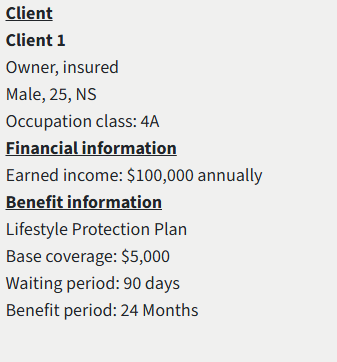
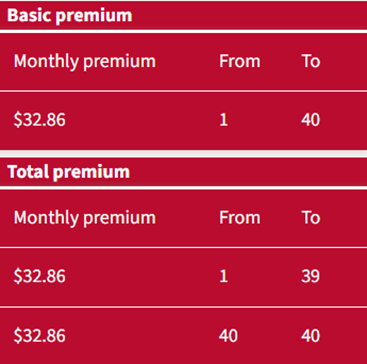
For the price of a Spotify and Netflix subscription, you can ensure that if you weren’t able to work, you’d be able to provide for your family for two years.
Then, consider if you also have disability coverage at work, meaning there is an even smaller gap to fill. If he only needs $3,000 coverage it’s only $21!
I know I’ve gone on for a while here, but disability insurance gets overlooked far too often for the incredible value and protection it provides. It offers peace of mind for you to recover while still providing for your family and relieves the burden of financial stress, and you won’t drain your savings and push yourself farther from your financial goals.
But remember, as you get older and health worsens, these premiums do go up. Proactiveness here is everything.
Term Insurance
When someone says the word “insurance” for most it’s life insurance that first comes to mind – and it’s for good reason given how important it is.
There are two main types of life insurance – permanent life and term life. In this article, I will only be discussing term life insurance as I believe it’s the superior option for young professionals (of course, there are exceptions to this. Maybe I’ll discuss permanent insurance further in a later article).
You’re likely familiar with what life insurance is but if not – life insurance provides coverage on your life so if you were to pass, the named beneficiary or beneficiaries receive a tax-free death benefit. There are a couple important titles on these policies that you should be able to differentiate.
The policyholder is the person who owns the contract. They determine the beneficiaries and whether they want to keep the policy active.
The life insured is the person whose life is insured by the contract. In other words, if this person dies, the beneficiary receives the death benefit. The policyholder and life insured are often the same person.
Finally, the beneficiary is the person(s) named by the policyholder who will receive the death benefit should the life insured die.
This information is true for both permanent and term policies. So now let’s dive into term insurance specifically.
Term life insurance is a contract that promises to pay a death benefit to the beneficiary upon the death of the life insured over a set period of time or to a specific age. It is typically used to cover temporary financial obligations.
This is the fundamental difference between term and permanent. Where permanent (as it sounds) insurance will remain active over your entire life, term insurance only remains active for a determined period of time.
We’re not going to get too deep into the details here, the most important part is that you know the basics and you understand why it's a great choice of coverage for most people our age.
Why Would it be Beneficial for Me?
The main reason term insurance is a usually a better choice for young adults is because it is so cheap. You can get a high amount of coverage for a very affordable price. Most people are starting a family, taking out a mortgage or paying off student loan debt and don't have a ton of discretionary income. On top of that, no matter how long the term, your premium will not change. What you pay per month today will be the same thing you pay 20 years from now.
The best way to convey the value of term insurance is through an example, so let’s use Mike again for another example. A lot has happened in a year – he is now 26, recently married, and has a three-month old baby. His wife, Michelle, quit her job and plans to be a stay-at-home mom indefinitely.
Mike and Michelle are now looking at buying a home to raise their family. They found a home they like and plan to take out a mortgage of $500,000 and will be paid off over 25 years.
Now, lets say Mike – the sole income earner – tragically passes away two months alter in a car accident. Michelle is now an unemployed mother of a five-month year old child and is responsible to pay a $500,000 mortgage, on top of burdening the loss of a loved one.
This truly is the worst case scenario of those “what ifs” but unfortunately it can happen.
But this didn’t happen – because although Mike still does pass, but once he took out the mortgage he also decided to take out a $500,000 25-year term policy because he considered the "what-ifs".
His monthly premium was…
$35.10
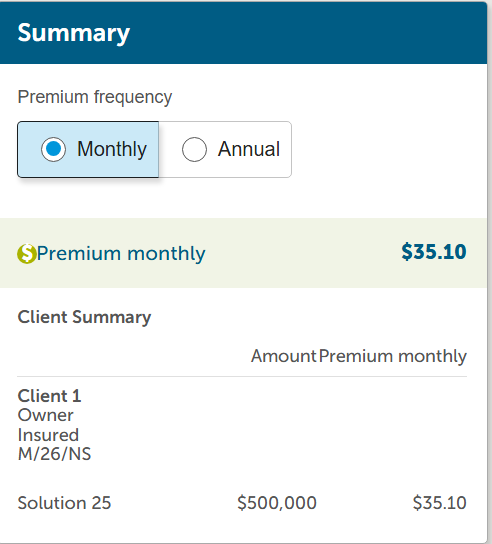
At his passing, Mike paid a grand total of $70.20 to provide his wife and child with a $500,000 benefit.
Instead of worrying about how they’ll keep a roof over their heads, Michelle now has financial flexibility and time to make important decisions for her family.
That’s the value of life insurance.
Why Not Mortgage Insurance?
In this scenario particularly, you may be wondering “why not just get mortgage insurance?”
Let me start by saying mortgage insurance is almost always a worse decision to cover your mortgage than using term insurance for a number of reasons:
First, since it’s tied directly to your mortgage, even as you continue to pay off more of your mortgage your premium stays the same.
Second, the policy is tied to the loan. If you switch lenders or refinance, your insurance is cancelled.
Third, any payout goes straight to the bank, not a beneficiary. You lose the flexibility term insurance offers since it allows beneficiaries to use the money any way they see fit.
Fourth, it’s often much more expensive.
The only scenarios where mortgage insurance might be a better option (but still unlikely since you’re young) is if you’re a smoker or if you have pre-existing health conditions that would be uninsurable.
But if you’re healthy and insurable, the two aren’t even comparable.
Certainly, insurance isn’t the most exciting part of financial planning. Most would rather talk about investing, buying their first home, or wealth building strategies. But protecting your financial future is just as important as growing it.
Ideally, you’ll never need to use your disability or life insurance policy, but if one of those “what ifs” happen, you can prevent a difficult situation turning into a financial disaster.
It’s not expecting the worse, it’s being prepared for it, and it’s that preparation that makes a true financial plan.